Mt. Etna

Our guide, Eddie, proved to be a man who could spot an edible mushroom 60 paces from the window of his speeding Land Rover, while “laboring” under the light demands of his paying passengers. On the bright side, we learned nearly as much about woodland fungus as we did about the currently sedate volcano he was hired to show us.

To milk the volcano of tourists dollars, the Sicilians have dug roadways through a swath of recent lava. Rod is standing a the edge of the flow. Whatever the mountain engulfed in burning rock is lost to history, but there are many examples of farms and towns snuggled unwisely at the edge of a previous flow, saved they think by the almighty, whose fiddling with the laws of nature must blunt scientific inquiry. Eddie took a blurry picture (probably because he saw a distracting mushroom) of us four, showing that there really can be a light at the end of the tunnel…at both ends. OK, it probably is not a smiley face that Eddie is drawing, but I forget the science lesson.
fullsizeoutput_1a97fullsizeoutput_1a99

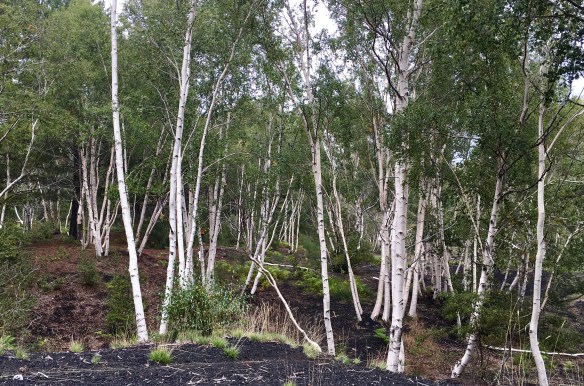
Why there are so many birches on the slopes of Etna was never explained, however, Stephanie told us that the search for the largest living organism on earth has been reduced to two candidates—a mushroom or a birch. What you see in the lower cluster, cleverly disguised as a  half dozen trees, is actually a single individual growing from one root system. You can see a couple of places where enterprising miscreants cut regular sections of white bark for use as canvas, like scrimshaw. This petty theft is unlikely to injure the tree, but it is an unnatural scar on nature. My walk was diminished. boo hoo

For billions of years volcanoes have been resurfacing the earth we trod today. During the last 500,000,000 years or so, life on the surface has been covering the basalt assault in a rock-paper-scissors struggle (sans scissors) by covering the seemingly lifeless rocks with invaders from at least two kingdoms, plant and animal, narrated by a naturalist wannabe.
img_0995

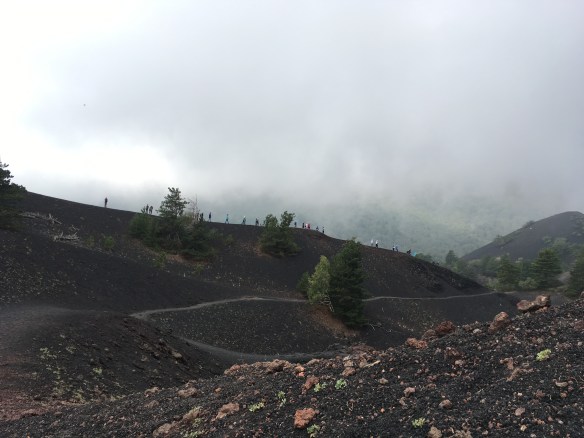
Up close, one can see lots of bits of vegetation, but the overall look remains bleak. How can a few trees have grown to maturity? The ridge hikers appear ominous, like marchers in a Pink Floyd video.

The mountainside forests have the common nut trees, chestnut and hazelnut. Chestnut, we did not know, are protected from the uncovered hand like a porcupine.

After leaving the mountain, we were treated to a lunch with wine tastings, where I tank for drew, Rod taking only the smallest sip of each. The vineyard’s view from our table was outstanding. The wines and cheeses were perfect. Everyone else additionally got some form of cold meat. I just got loaded.

The grounds, soaked by a rain during our lunch, were richly verdant.

Linguaglossa & Taormina

The drive to Linguaglossa (our only AirB&B stop) was almost uneventful, save the troublesome stops at a couple of toll booths, used by Sicilians to support a depressing socialism, with welfare, obscenely long vacations, childcare, and low crime. Takers! But I digress—as we did on the last kilometer (the American word “mile” is shorter…ha ha ha) trying to find the street listed, deceptively, as our destination. Rick navigated the narrow turns that took us around the target a few times until, by astounding serendipity, Stephanie saw a faded scrawl on the side of a building that could have been graffiti but was in fact our street paved path. This passage was easy to miss—as likely to have been a wide doorway as street, meandered 100 meters uphill, its ungenerous girth regularly narrowed by a pipe or wire on a building. There were, need I say, no sidewalks.

We squandered 30 minutes or so trying to rouse our host or disturb a neighbor enough to pry a free hint as to where to put our bags when a smiling refugee on a bicycle greeted us with limited Italian and no English, coaxing us to follow him to the “House of Stone.” He rode charitably slow, given how easy it is to negotiate streets on a 2-wheeled vehicle—no fair. Nice place, though.

If only all towns had streets as Bertha-wide as the driveway. This view, featured on the AirB&B web site, is not visible from the listed address, on the street below. (The owner should consult for treasure-hunt apps on iPhones.) Basta with the complaints already.

Our spirits undampened by frustration or occasional sprinkles, we set off for the 15 km drive to Taormina, which missing would have been a grievous error.

The popular tourist town is owed another visit, as we did not get down to the beach, at least 100 meters below, or to the castle, a couple hundred meters above. If ever I take a Mediterranean cruise (when I am much older), Taormina must be on the itinerary. Spending a week on its beach is looking more attractive all the time. Lie in the morning sun, hike to the town for lunch, ask the local girls to braid my hair…what is left of it.

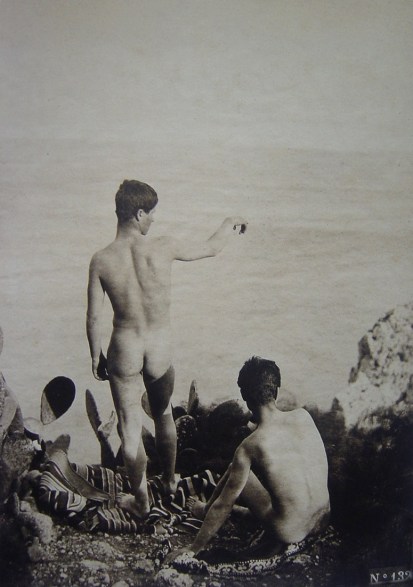
image-10-10-16-at-1-14-pmThe town’s fame has been enhanced by the work of the German photographer, Wilhelm von Gloeden, who photographed many nudes, mostly male, in the early 20th century. Today, he could spend three life sentences in an American prison for having models who were younger than 18, though in Europe, he’s considered an artist.
Gloeden lived most of his life in Taormina, which can be considered a tribute to his good taste…as is his choice of subjects [in my homo opinion].


Before we found the primary tourist street inside the town’s walls, we lighted upon a perfectly acceptable outdoor place to lunch with a delicious rosé wine. In Italy, even simple meals are served with care. I saw no fast food in Taormina…or almost anywhere else in Sicily. Fast food in Italy is a stop by the gelato shop on a hot afternoon, not a meal. Meals are fleeting joys, like full moons, to be enjoyed whenever possible. How did Americans come to believe that a chance to sit with friends over a casual repast and conversation is something to be rushed, like the incongruous oxymoron “fast food”?

I am determined to climb to this castle one day. (Better be quick about it.) There is a spectacular Greek theatre on a lesser hill, which we did not visit for lack of time (lines of tourists). A week here, with time invested on a sandy beach, would barely be adequate.

img_0816


Archaeological Days

There were two sites of archaeological interest on our schedule. The first, a museum, which starts chronicling the history of Sicily from about 300,000,000 years ago, had a display of great interest at the ticket counter. Stephanie and I agreed he was stunning. The whole museum was peppered (if that’s the word) with such students, perhaps working for a stipend as part of their studies. It was interesting to see a fine museum staffed with young people in casual clothing.

The progression of civilization on this large, historically significant island is hard to overstate, but I’ll do my best. Early settlers found flint to be a useful substitute for claws and saber teeth. An enlarged brain provided additional advantage that has since been abandoned by Trump supporters. One witnesses the progress of crude pottery taking on attractive shapes, then colors, then glazes. Attention to detail eventually gets to parts of the human form that assumes an enlarged place in human history.

I have always been curious about the black on terra cot genre that captivated the Greeks to the near exclusion of all else for a huge percentage of their glazed pottery. Has art ever been so lacking iconoclasts? Or did the potters see Prometheus and say, “fuck that.”

Eventually, the Romans dropped by, the roads got better, women are said to have gotten more attention, and anti-intellectualism bloomed in the bloody theatre. Archimedes was stabbed to death by a Roman guard who must have one too many axioms stuck up his ass. Thus, Syracuse declined for a while.

The museum was so large and intriguing that we left the outdoor ruins for another day. As I hope you agree, it was a day well spent.

A day at the actual site of the Greek and Roman ruins is hard to describe, but I have made a questionable attempt with the following video:

My thanks to Mozart for proving the only part of the audio that wears well on the ears. I can see all the flaws in this, but the pursuit of perfection (or even a 6th grade level of competence) would mean that I could never finish this blog.

Thanks to Die Entfuhrung aus den Serail, K. 384, Neville Marriner – Academy of St. Martin in the Fields, for not suing me. (I hope.)

The afternoon lunch, back on the island of Ortigia, was enjoyed in a courtyard restaurant, canopied with grape vines. 

Ortigia, Syracuse

From the start, Syracuse had promise, convenient parking, a hotel along the water front, a room on the 3rd floor (our 4th in the US, as we object to a floor zero) with a balcony, all in a smartly renovated grand building, and warm, sunny weather.

Stephanie had a restaurant recommendation, giving her a mission. We three old men hustled along behind, sheepishly oohing and ahhing at the wrought iron terrace rails, elegant cornices, heavy wooden doors with big knockers, narrow alleys that curve out of tantalizing sight, while she who must be obeyed, map in hand, head high in watch for helpful street signs, led us to one of the most outstanding restaurants in Sicily. We were wise to have followed. (But we would have done so if stupid, too.)

Rod ordered shrimp with tomatoes, while I made the superior choice of fava bean cream with fried salted cod. The shrimp were too lightly cooked for his liking, so we swapped dishes, ¼ eaten. I gesticulated like an Italian (the only thing I can do like an Italian) to make some now-forgotten, cogent observation, cleanly knocking an expensive glass of Sicilian white across the absorbent table cloth. The staff were quick to blot the spill with fine table linen. I ordered a replacement bottle, assuring a long lunch.

The Rogers had a tasting menu of various small dishes. My attention was too preoccupied to record each dish, but I can explain the photos. (ehh, maybe not—”fave bean” is what the menu said)

It was a leisurely lunch. Last to leave, we probably cut into the staff’s siesta or other plans, so an invitation to return remains unexpected. The most expensive meal on our trip, it looked like lots of pizza over the next week…one could do worse. We didn’t.

The Mediterranean tradition of sleeping off one’s lunch alcohol worked well for Rod and me—well, me. Rick and Stephanie explored more of the city; Rick demonstrating a humiliating resistance to early retirement.

In the evening, we found the streets buzzing with excitement. This was the Saturday night before the start of school’s fall session. Half the crowd was under 25—the better looking half.

Italian youth rarely raise their voices when gathered. It seems like respect for elders, but I doubt that they even see us—we move like trees—but they do not draw attention to themselves among their friends. Americans pride ourselves on individualism and find lots to appreciate in that, putting celebrity and wealth above family and friends. Europeans value community, which gives them healthcare, free college, and gun control. We have Facebook and Donald Trump; they have slim bodies and stylish clothes. Tough choice.

A couple of young lads, perhaps 12 or 14, were briskly walking up a broad, pedestrian street when one spotted a couple of friends his age. He pulled his companion over to greet them, kissed each friend lightly on both cheeks, introduce his friend, who shook hands. That seemed so foreign to me, but perhaps it is harder to punch or to shoot someone you have just kissed. That has always been that case for me.

We met an artist with an exhibit at a huge gallery (old, empty church). We were his last admirers of the day, but he spent time with us explaining his work while pacifying his infant son. Rick and Stephanie bought a stunning canvas from him. I took a photo of an engaging Greek subject, as is my wont—want?

Via Romana Del Casale

It must have been some time during the 4th century A.D., because that is what the sign said, a rich Roman decided to build a modest house with a private chapel, hot and cold baths, rooms all over the place…you get the picture, just what everyone needs in a country home. He and his slaves are all dead, the baths are dry, the roof caved in, and when it got excavated over the last couple of centuries, only the floors survived in a state worthy of gawking, which was our intention on a hot Sicilian day in Aidone.

This is obviously a good time to be brief, unless you care about mosaic floors—and who doesn’t? Click on any of these images to get an enlarged view.

It is hard to say why mosaics have such appeal, but the place was busy with paying tourists. Mosaics last longer than walls and ceilings. For one thing, floors rarely fall. If your boss in the year 397 had 40 rooms to be inlaid (or laid in), you could probably put off fear of starvation or of being tossed to the lions for a few years. For some, that would beat working at Amazon.com.

The Sicilians make tasty looking food, and it is (nearly) always delicious. Almost every dish could be photographed and put into a recipe book. This was our lunch, beautifully presented. Everything would have been great, but the fearsome trip to the Bristol Hotel was made more difficult by a street party that had closed access to the hotel. By happenstance, our helpful, handsome desk clerk walked by our stymied car and advised us where we could snag an overnight spot, a substantial distance from the hotel, but it proved to be a pleasant walk back.

The street party was noisy, simple, and filled with young people. I liked seeing so many kids out at night without a hint of  rowdiness. We found a large pizzeria away from the madding crowd. It was entirely adequate.

Agrigento to Enna

The hotel at Agrigento was modern. We enjoyed a bottle of prosecco on a patio watching the sunset and had a late-night sandwich before bed. Even luxury hotels seem bland in comparison to the old palaces with modern plumbing  procrustean-fitted into odd spaces we have been enjoying. Our luggage loaded, we fled to a local Greek ruin.

Sometime after the turn of the 21st century, Icarus fell to earth near a temple to someone who never existed and whose name I have forgotten. Curiously, his wings and torso were kept intact, much appreciated by the giggling tourists who stood bravely by his immodesty. (What’s to be modest about?)

The drive into Enna was by far our most challenging on Sicily. The GPS led us up a steep narrow path to a car that was kindly blocking the road, which I mean sincerely. The tapering street was going nowhere, so the careless parking saved us perhaps another 50 meters of descent in reverse. The correct route, not much wider, we would have abandoned except for an occasional sign on the way reading “Bristol Hotel.” Options were few, so the signs served mostly as reassurance. Stephanie rescued us by actually asking in Italian for directions (I was so manly embarrassed). A women offered to lead us in her car to the hotel, grabbing for herself the last, legal parking space. See! So much for seeking help.

We parked in a handicapped spot, which we had earned by this time, and a handsome, dark Italian youth (they are everywhere!) ran out of the hotel to assure us that he would move the car as soon as another spot was free. The turns to the hotel were so tight that some were 2-point turns for our experienced guide. Confident no tow truck could get into Enna, much less punish our parking sin, we checked in.

Though I could not understand a word he said, the hotel clerk, who gave generous Italian directions to Stephanie, has a musical diction of rolled ‘r‘s and canolli-crisp ‘t‘s that had me enthrall, as if listening to a budding tenor. Perhaps it was not the public school system that taught respect for his language, but the lesson, whatever the source, he had taken with pride. Oh, that we could imbue such musicality and rhythm into American conversation.

His directions pointed us to a restaurant first approached from the rear. A waiter spotted starving tourists (perhaps alerted by our hotel guy) and marched us through the kitchen and dinning room to an outdoor table protected from the mountain sun by wide awnings. What a lunch it was.

After lunch we hiked to the east end of the city, where a castle once protected the citizens from roving mobs of foreign knights. One character, photo below, looks like a member of the KKK. The castle was open for anyone to wander at no charge and no oversight. Lean over the parapets at your own risk.

Enna makes few compromises to modernity, but at night kids clustered in cheerful groups below our balcony chatting, the faces of their smart phones flashing like fireflies in the murky chill of the night. They are nice kids. Never yelling, but the stone surfaces around the plaza amplify their friendships. My sleepless night wondered what it would be like to be among them. If only I could speak Italian.

The people of Enna have access to new cars (few are SUVs), cell phones, computers, 220V current, and all modern appliances. The town may look worn, but beneath the surface, people are healthy and well dressed, interiors are renovated. They are middle class—comfortable.

The center photo shows the single inlet to the hotel’s square. It is 2-way, though you may wonder how a single car squeezes in. They manage. Someone is first, a car in the opposite direction backs down. There are no rules, but it seems as efficient as it can be.

Does respect for the past result in respect for the present? I grew up in a city where many fine buildings were razed to accommodate a cheap shopping mall and ugly parking lots. The people of Enna live with 500-year-old, mostly unadorned buildings that people like us flock to. Do cities that revere the past build carefully today?

Some Italians build with the expectation that future generations will live with their decisions, but the devastation of an earthquake in the Italian mountains three weeks ago where over 300 people were killed by shabby construction, including a modern school that collapsed, thankfully empty, in the night, is a testament to corruption and greed from the Greeks to the present. Can we knit the past to the future? Or is that just for old wine?

An Italian Experience

I confess that a part of the joy of this day, not the only part or even the best part, was the knowledge that my brother Bob would experience real envy at my getting meet so many wonderful people. Stephanie’s cousin invited us to lunch with them at their country cottage, set into a Sicilian hillside many generations ago, overlooking the village of Mezzojuso pictured to the right as seen from the spot where everyone is standing in the  picture on the left.

Our host, Johny [his spelling], spoke conversational English, as did two others. Otherwise, we were on our own—mono-lingual Americans. (I like to presume that foreign speakers will presume my other language is French, or Spanish, or Swahili, but bilingual people know that non-Americans always carry a language brief of the countries they visit.)

image

From upper left, Rick Rogers, son of dentist, girlfriend of dentist, mother of young girl, 95-year-old survivor of German prison camp, dentist, daughter of dentist, father of young girl (I hope), young girl, Rod, me. Missing are the two hosts, Stephanie, and a hired hand. Apparently, they were making the meal we were about to eat.

The table was set outside. Rod and I agreed to sit separately, though only a few people spoke English. My dinner partner was a tall, handsome, college student with pretty good English and marvelous eyes. He is studying math at Pisa University. I could go on…

The food was exceptional—duh, this is Italy. Two kinds of fish, tuna and swordfish, were pan seared with an olive, tomato, caper, mint sauce. I am sure the cook had other secrets not divulged. The fish was served with side dishes of caponata (eggplant with celery and what must be myriad spices), sliced zucchini saluted in oil and spices, and a generous basket of Italian bread. I accepted a second helping of fish and found that I was finishing my meal last! I wonder how long they will talk about that fat American who could not stop eating? The feast was rounded out with prickly pear cactus peeled and lightly sweetened in ways I cannot guess, watermelon, various Italian cookies, and outstanding coffee.

After lunch, our host guided everyone to an abandoned monastery where a few devoted artisans work to restore ancient artworks and old books. They are particularly proud of a printed anthology of Plutarch, including his Lives of the Noble Greeks and Romans, which is printed in fine-lettered Greek. It is believed to be one of only two copies extant, the other is in the Louvre. Odd that the book is being so man-handled by a restoration expert.

This will be a day long-remembered and something that other travelers cannot match. We left the group, who were headed for gelato, to drive on to Agrigento before dark.

Erice (3 syllables)

Imagination can disappoint, raising expectations without cause, but in Erice it failed to overpromise. The town is perched above Trapani and the Mediterranean just beyond, so I was prepared for a sweeping view from the third row of a crowded café. It is much more.

Erice has what another town has Caprisciously abandoned—good taste. It is warm and charming, without a gauntlet of designer stores nipping at the fatted wallets of the savage rich. The art works in Erice are unique; the famous pastries, unreplicated at Starbucks; and the stonework, outstanding.

La funivia is a cableway system to rise the 703 meters (over 2300′) to the city gate. It is 10 minutes well-invested. The city of Trapani makes the scale of the lift tangible. Everything is stone and the claim is that the cable system did not exist when someone lugged this stuff up the hill. Ouch.

Walking through the gate of ancient Erice, one quickly realizes that this is a special spot. Even the paving stones are both irregular and congruent, their varied surfaces polished smooth as St. Peter’s foot by the touch of the adoring multitudes. The gentle slope passes a series of small shops, lacking the intimidation of the pretentious Capris.

Stephanie discovered a marvelous pottery shop, securing the lightest gift the owner had, and it was free: restaurant advice. As a result, our lunch was an outstanding pleasure.

Rod and I shared ravioli with a swordfish stuffing and grilled onions, while Rick and Stephanie had beef carpaccio with rocket and parmesan. These were so delicous that my readers were forgotten until the crisp, fresh cannolis ended the lunch. (How on earth did they cut them in half? They shatter with each bite. Did they use dental floss? A laser?)

We walked off lunch (I wish) with a hike to the far end of the city where a castle stands prepared to defend the Erice against any threat, excepting aeronautics and gunpowder. It worked for quite a while. Had they had the foresight to build greenhouses and water pumps, even sieges might have failed.

The return to Castellammare del Golfo had us looking for a bar, which happened to pop up across from our parking spot. The British-accented Italian bartender made up two negroni cocktails, a beer, and a lemonade for €18. He included a ham sandwich cut into four, a bowl of chips, and a cup of olives, without charge. I could get to like these prices…except for the ham.

Sicily

Our automotive tribulations had not ended. We left for Naples airport in the wee hours for a 6:55 flight. We should have been amply early, but when we neared the airport, a snobby voice announced, “You have arrived at your destination.” Our location was a dark underpass with nothing in sight. The GPS then led us…blah blah blah…after a quick scan through security, we ran to the gate to find that our plane had just pushed away, resulting in a 12-hour wait for the next direct flight to Palermo.

The Naples airport is like any other with 85˚ air, screaming children, hard seats, and limited wifi (4 hours max). I used a cheap pen and tiny notebook to complete the last two blog entries. Nothing is going to spoil this trip. [Just wait to you see the roads in Sicily!]

Stephanie and Rick were good sports about the missed connection and returned from Castellammare del Golfo to the Palermo airport to retrieve us at night. After checking into our beach hotel, we found an outdoor restaurant on the sand, with a warm breeze, a cold wine, and a buxom waitress with weak English and strong opinions as to what we should eat. I obeyed.

The bruschetta was outstanding as was the local wine. Though we had sat down famished, the heaping plate of busiata, a Sicilian pasta wrapped in curls tighter than the young Shirley Temple’s hair was far more than I could eat, sending back to the kitchen a mound of food that could still feed two hungry adults. Perhaps it did. Hope so.

There are no pictures of this feast as Rod and I were busy pretending that all the inconvenience of the day was an adventure we will treasure for years, rather than an ordeal deserving a cyanide capsule.

Rod had decided before deplaning that Rick would do most of the driving—and all of the driving to be done from the seat behind the steering wheel. No protesta. We left in the morning for Selinunte, a site of Greek ruins that appealed to me for what I hoped would be a flattering personal comparison.

These few photos are reasonable examples of typical Greek ruins without the statuary immodesty that intimidates. Left are the stones not carted away by marauding architects from the successive dim ages, each tearring down the last, both theologically and structurally. The most effective Siva is the quake, toppling pillars like Steve Smolen does bowling pins. (But without the masculine pretense.)

After a rest, we ate at a fine restaurant a short walk from the hotel. One must have a destination for dinner to prevent being stopped by, usually handsome, restaurant barkers luring the undecided into mediocrity. Stephanie with her gregarious Italian, always manages to ferret out quality. Sometimes in doing so, she makes a life-long friend. In this case, it was a dinner-long friend, who made all conversation bilingual.

Trip to Capris

Put the stress on the second syllable at your peril.

The geologic beauty of Capris rivals the Hawaiian islands, but the social excesses began when the Roman emperor, Augustus, bought the whole thing as a summer retreat, and that selfish tradition persists to this day. High-end shops gob the streets like coarse sugar on sweet marmalade. Watching the rich display their contempt for restraint is repulsive; I’d rather see a soccer team comparing their genitals…much rather.

Capris is like a priceless antique diminished at the hands of hack with urethane. Sprinkle enough of these people in NYC and LA and Trump would have himself an election.

We quickly took a bus to Anacapris, the island’s other city, a tribute to the linguistic creativity of the Greeks. At the start of this short ride, Rod’s sanity had lost a debate about whether we should take a chairlift ride to a blistering, sun drenched height atop the island’s  2000′ peak. His resolve was not to last.

Along the narrow, hairpin road that our bus driver sped his rickety tub, the right side of the road gave way to a 1200′ drop, guarded unconvincingly by a tastefully low barrier. The passengers let loose a collective gasp as the brave boast of a chair lift melted like soft gelato in the August heat.

image

View from the bus

This photo was taken on the return trip from the far side of a narrow road.
When going up the road, the rail was not visible, the cliff is shear, the drop, astounding.

We settled for a pizza and beer under the shade of a canopy. As Marc Antony once spat, “Ambition should be made of sterner stuff.”

It was in Anacapris that I filmed evidence of the driving styles of Italians for which I have included a short video:

It appears that the bikes at the end of the video stopped, but in fact they barely slowed. I nervously stopped filming—as if the cop would care about me. He was just getting out of the sun. If people stopped at intersections, of which there are countless, the country of Italy would cease to function.

Italy has given less regard to automotive traffic than the US. There are a few highways, but city buildings and neighborhoods have resisted demolition done just to relieve congestion. It often seems incredible that two busy areas of a city are connected by anfractuous routes, barely wide enough for an economy vehicle, but such is the country’s subservience to la dolce vita.

A short stretch of water separates Capris from Sorrento, so we made our way back in time for a cold beer in an unpretentious town. Sorrento is blithely indifferent to threats from sea rise (except for the docks). The cities of London, Paris, and Hamburg will envy New Orleans after Katrina before Sorrento has persistent puddles.

At the top of the many steps from the pier to the city’s flat streets stands a statue of St. Anthony, patron of long, enduring friendships.

Amalfi Coast

There are three ways for commoners to experience the Amalfi Coast—boat, bus, and car. The boats have vantage, but cannot help the traveler reach the high towns, like Ravello; the bus takes control of the pace away from the individual; and the car requires a competent driver. We unwisely chose the third, with terrible results.

The famous drive is along a south-facing wall of rock where outstanding engineers have scratched east-west roads into the surface. It is a two-dimensional world where each town is an inescapable node. We escaped twice.

The first was a spelling error when my navigator entered “Revella” for “Ravello.” The GPS spitefully sent us up 30 km of monkey intestine before the road narrowed to a coarse grind of right fender and left mirror between roak wall and stone building.

The second was again the fault of the GPS when a critical left turn was acerbically acknowledged after the fact by an exasperated voice, saying “recalculating.” Turning around on these roads, using a many pointed forward-reverse would certainly block a hundred horn-loving Italians, and might still fail. Our bodiless GPS companion then turned the drive back to our hotel into a 4-hour odyssey, landing us in Sorrento, after dark, when the main drag, the only drag, was closed for a weekly party. Ahhhhh

Misadventures not withstanding, we enjoyed the towns of Postino, Amalfi, and Ravello, eventually. Amalfi sports a parking lot with the orderly inspiration of sitting in line for Trader Joe’s one-out, one-in system. We queued at a swing-arm gate awaiting a token first deposited by someone leaving. Within each token is a computer chip that has the arrival time encoded. Cool.

Amalfi is positioned at a fissure, allowing a footpath to worm its way a thousand meters or more from the sea. We stopped for a short lunch, chosen for its boast of a/c more than the food, but neither satisfied.

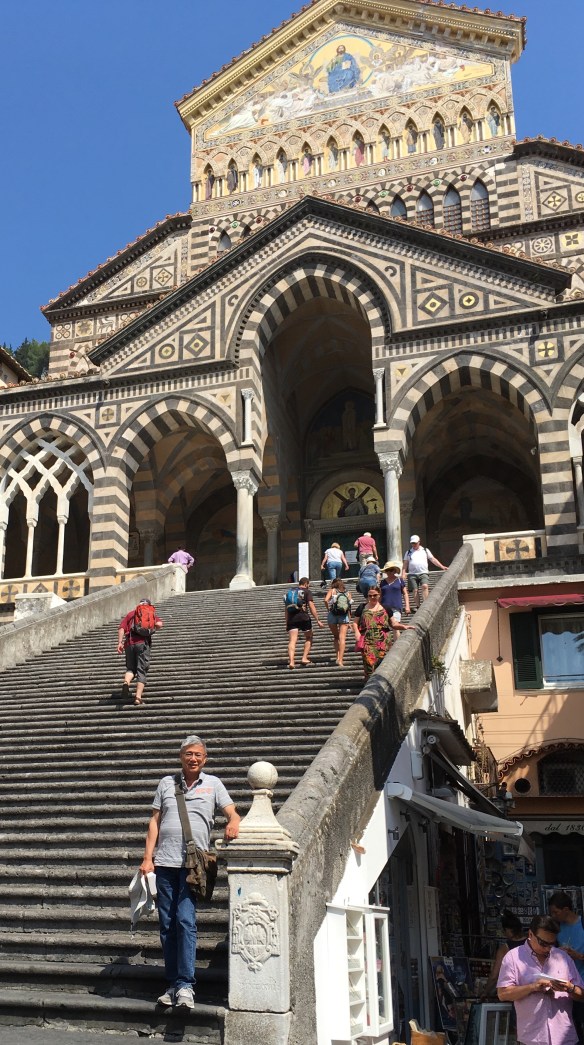
Rod paused before a cathedral that could have been Led Zeppelin’s inspiration for Stairway to Heaven.

image

Cathedral? Does every village in Italy get a bishop?

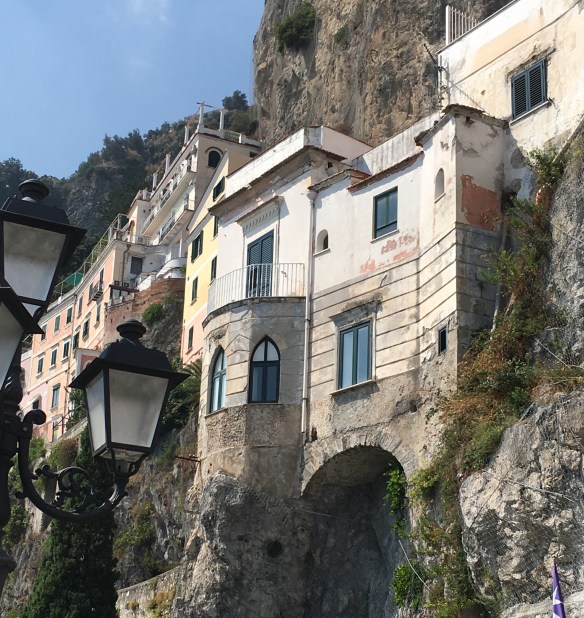
Typical of fine construction in igneous Europe, homes emerge from the stone.

image

Rock of ages…one hopes.

The ocean views exceed most of California’s, largely because the ancient towns cling to impossibly precarious niches. At various points, the road narrows to a single lane, alternating directions. Tour bus drivers pass each other with barely 6″ to spare—and I know what 6″ looks like.

The town of Ravello, where Gore Vidal lived for more than 25 years and Greta Garbo was able to be alone, is the direct opposite of Postiano. It sits high above the sea, showing only a tease to the passing yachts, while Postano spreads her inviting charms at the water’s edge. Each has its allure. One flirts with every passing admirer, the other is cool and discrete. Odd that Vidal would have chosen the latter, but opposites are said to attract.

Our driving ordeal was set aside with a fine meal in Sorrento’s central square. I was tempted to trying the Boston scallops to judge their authenticity. Rod erased the glutinous memory of the lunchtime gnocchi by trying his luck with a splendid evening plate of the dumplings served with sea bass in a white cream sauce.

For secondi, I had spaghetti pomodoro, while Rod got duck breast that failed to find tummy space atop the fully consumed starter.

And for dessert, Rod has a repulsive conversation with an English [bleach] blonde airhead who just loves Donald Trump. We departed amicably, just shy of  bulimic bout, while I found her older, rich companion a better conversationalist than sommelier of fine women, corkscrew or not.

Naples Rocks, Lots of Rocks

Italy is filled with cities and towns that have built imposing monuments to the glory and grace of God. Naples is no different except that it appears to have paid for the meal before it was served, as the mosaic at the top of this post depicts (in my imagination). The response from the ill-fed residents is to ignore traffic laws (if there are any), to take what is not theirs from tourists, and to party ferociously into the wee hours. The following video is an example of how hard they have tried to get on the big guy’s good side (Pompey showed, He does not have one):

A satisfactory effort, IMHO.

Stephanie Rogers alerted us to a chapel (no pews) to see some extraordinary sculpture at Cappella Sansevero. This remarkable museum is at the corner of nothing and nowhere. The unadorned exterior is easier to miss than the ticket office with the virtual sign, “Stand here if you do not know how to queue.”

The builder was a Freemason, so all the artwork is filled with symbolism. For instance, a torn book at the veiled mother’s feet symbolizes “a life interrupted.” I had wrongly guessed “an unruly child.” The ability to make stone transparent is amazing. Why not make the walls of cathedrals with this technique to save on staining glass?

In the creepy crypt below stands two bodies with skin and muscle removed to expose an elaborate circulatory system, with eyeballs. The blood vessels, we are told, are so accurate that many have speculated some eerie technique of injection, but that has, thankfully, been discounted.

We next moved on to the archeological museum, filled with really cool stuff from Pompey, a city that shows how much fun life was before being interrupted by Christian modesty and a mountain’s fart. These people were unabashed devotees of sex, with some outstanding variations on an old theme.

But Pompey wasn’t just about sex. There was plenty of mayhem.

The mosaics were outstandingly preserved beneath many feet of volcanic ash. Soon we shall visit the city of Pompey, as it has been gradually uncovered.

One hears questionable claims of marauding bands of pickpockets (don’t rest on my luck), but the threat from vehicular chaos is harder to exaggerate. I found an article on the web that had me laughing until my dinner was cold. Because web pages are unreliably maintained, I have stolen borrowed the text:

Italians are known as “crazy” drivers, and Naples is infamous for having the “worst” drivers in Italy!  However, this is because they simply follow different rules than Americans.  Or, more precisely, they only follow one rule:

The First (And Only) Rule of Italian Driving: Do not hit anything that is in front of you.

Corollaries to the First Rule of Italian Driving:

  • There are no other “rules.”  This means that quaint American rules like “always stop at stoplights/signals”, “stay in your lane”, “don’t drive on the shoulder/sidewalk”, “stop for pedestrians”, “don’t drive in reverse on the highway”, etc. don’t apply—as long as you don’t hit anything/anyone!
  • Sometimes this rule is mis-stated as “the car in front has the right of way.”  While usually the car behind will get out of the way of the car in front, Italians don’t think of things in terms of “right of way”—it’s just a matter of getting to where you’re going without hitting anyone.  For example, if someone is about to cut you off, your job is to let them in…or honk your horn so they know you’re not letting them in.  See?  No “right of way”—just a practical means to avoid collision.
    • Note that you do not own the space in front of (or around) your car in Italy.  When cars use this space, Americans perceive this as getting “cut off”, but Italians see this as “no accident, no problem”
  • When merging, getting into a traffic circle, changing lanes, or even crossing the street as a pedestrian, you just have to ensure that the cars behind you have sufficient time/space to avoid you.
  • Making eye contact means that you see each other and one of you will therefore get out of the way of the other.  Since it is often confusing which one will do so, it is often best to avoid eye contact.

I had an embarrassing moment right after the museum when I dropped into a small men’s shop to find a couple of shirts that were exactly what I wanted—cheap. In fact the original price was about six times the “sale” mark, which I guess is called pre-bargaining?

As I considered whether to try a medium or large, the amply bosomed seller snatched the garments from my hands before I could test the sticking strength and handed me an XL! Perfect fit. Very trim. You guys do this on pasta and pizza? Madonna!