London

Our hotel was literally (one might even say “playfully”—theatre district pun) in the throbbing heart of Leicester Square…intentionally. (It is the tan building in the middle of the image at the top of this page.) The activity for blocks around is unlike anything I have seen outside of Hong Kong. (Sadly, Greenwich Village, NY is not active at all, anymore.) The adjoining Chinatown has quadrupled in size and been polished since our last visit. Piccadilly Circus, so buried in construction back then that we thought it a slum, is a dazzling ring of neoclassical buildings with trendy, high-end shops and restaurants. (We ate one night at the oldest Indian restaurant in London.) What are redundant souvenir shops in many touristy neighborhoods, Leicester Square has theaters, casinos, Mike’s male strippers, day-of-the-performance half-price ticket vendors, a whole spectrum of restaurants, and myriad street performers. It is quiet from predawn until the revelers recover. My kind of place.
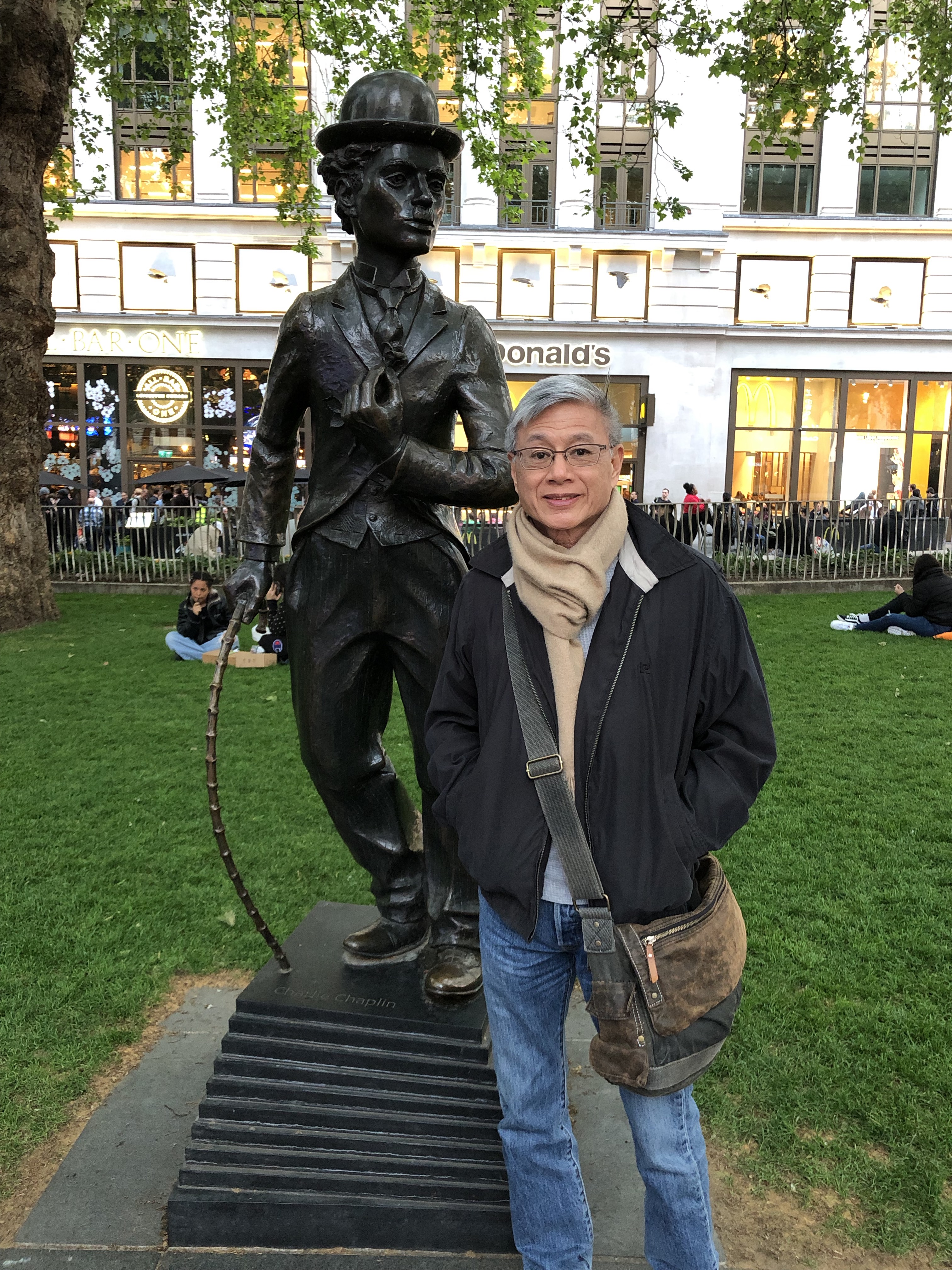
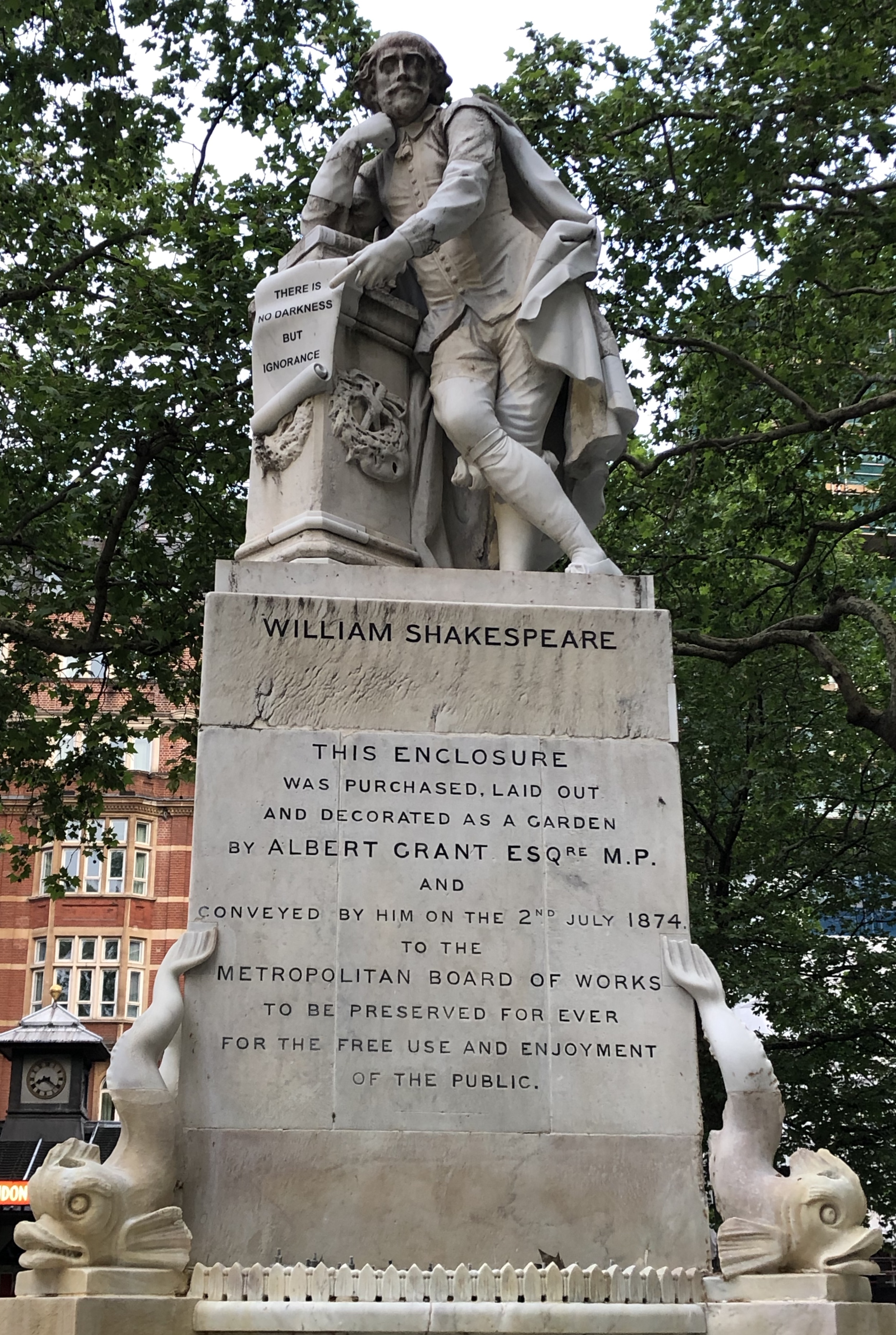
Charlie Chaplin and William Shakespeare are both immortalized in sculpture at this center of stage and film entertainment, though the Globe Theatre is a hike from here. (The boy just walked in front of the statue and I thought it a poignant reminder of why we create statues and plaques.)

There must be 30 plays running in this neighborhood at all times. Agatha Christie’s Mousetrap is in its 65th year, leading me to believe that if something beats this record, I probably will not be in the audience. (And if it is anything like Book of Mormon, I am pre-grateful.) As to what awards are given to gay bars, I can only imagine—but not in writing.

Some years ago, Prince Charles took a lot of heat for comments he made about modern architecture. I take his side in this. London has row after row of stately neoclassical buildings that are outstandingly beautiful, many refurbished and repurposed. Amid these are flat façades with unadorned, metal-framed windows and doors, the best of which are nondescript, the rest are just badass ugly. One such building in Leicester Square holds the worlds largest M&M candy store.

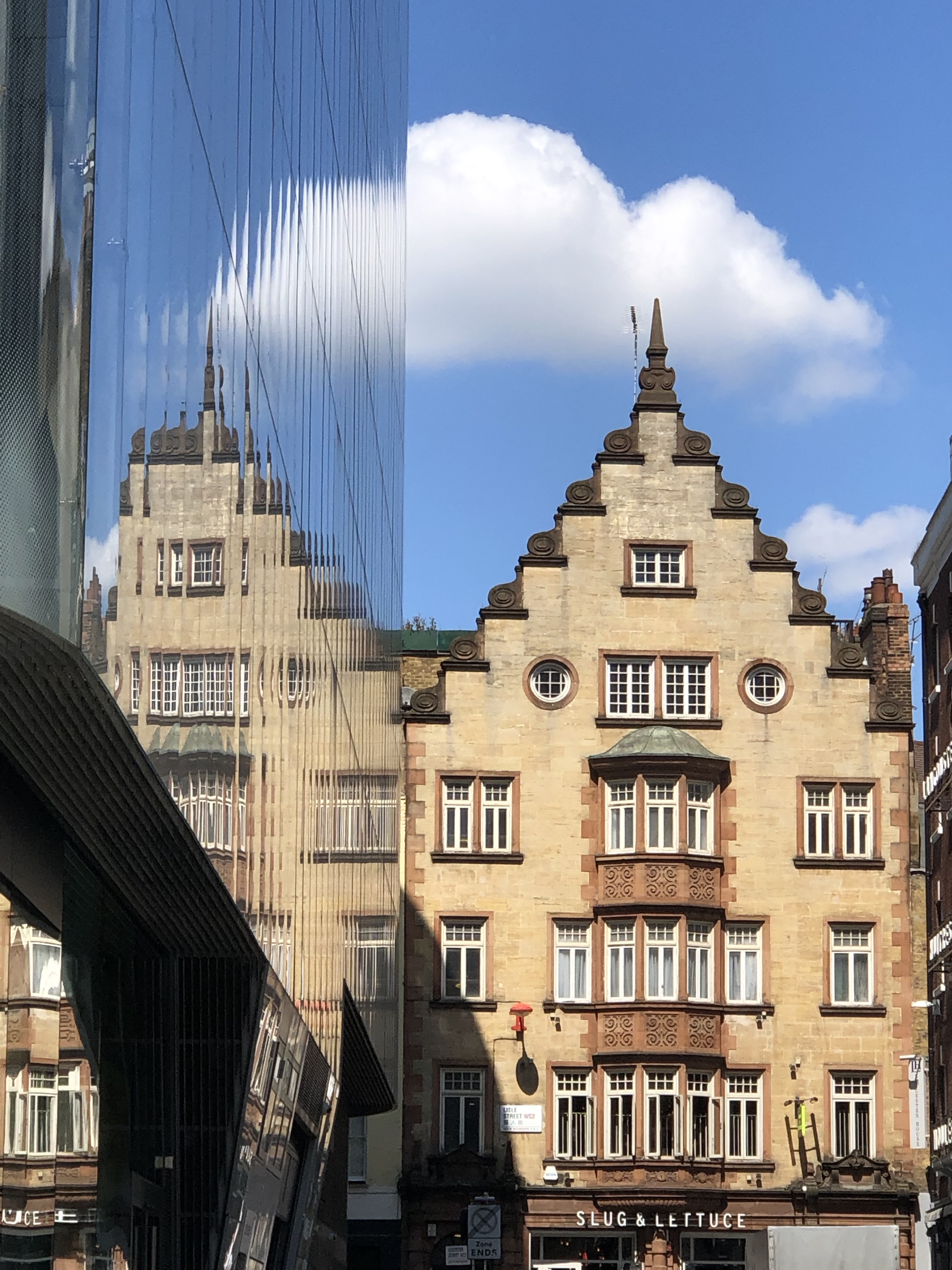
The best view of this building is at a sharp angle, where it can reflect the beauty of what came before and should return.

fullsizeoutput_1bc8

Here’s an example of indisputable ugliness. It has a certain dynamism, I concede, as it appears to be two buildings colliding, one buckling from the force. My guess is that Home Depot ran out of cork panels before the architect was finished adding rooms. By comparison to many, there seems at least a weak attempt to decorate the roof with a squashed beret.
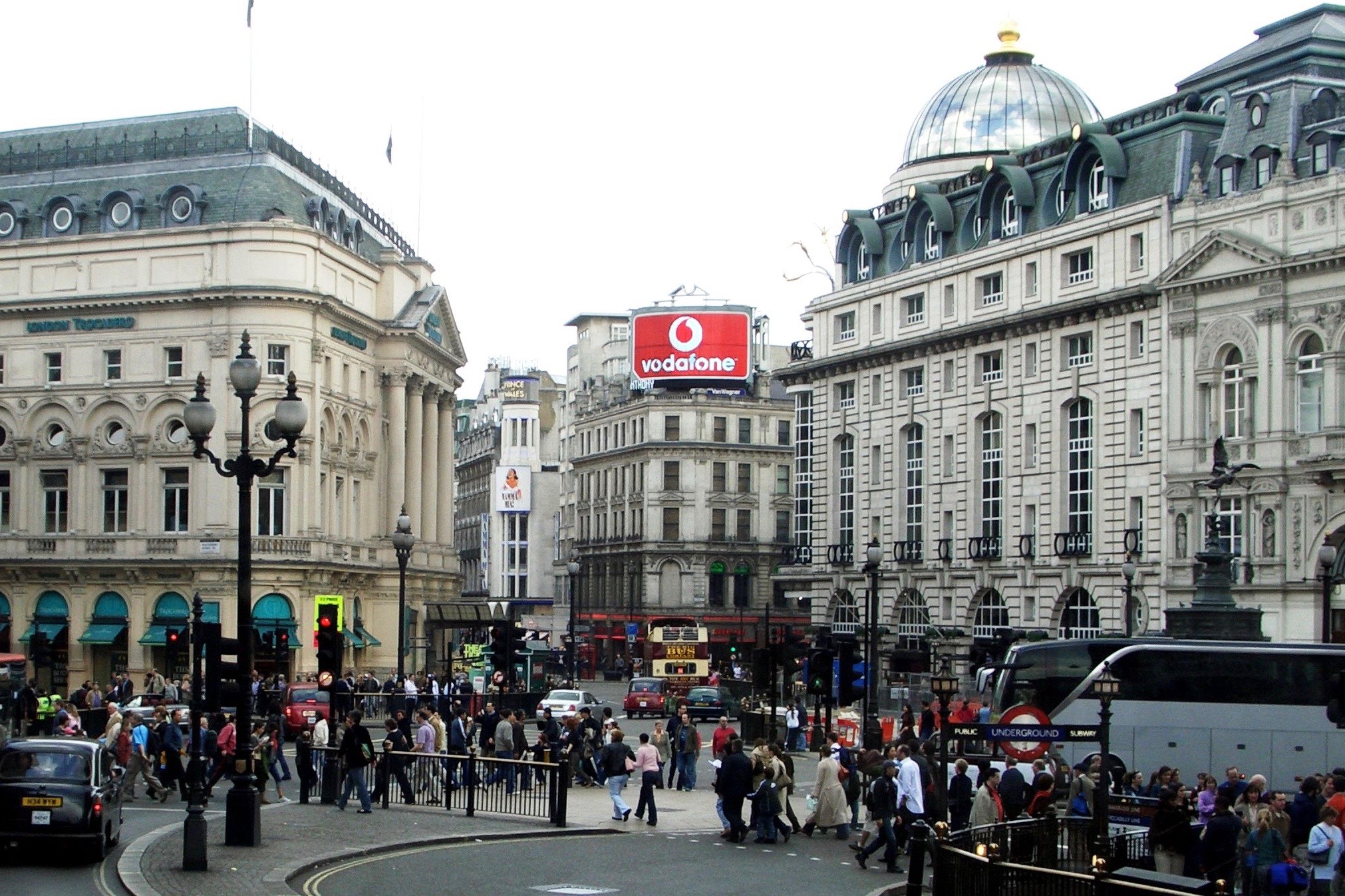
Could anyone find a modern square or the curved street out of this square done in modern architecture that would look not just pretty, but refined? How much deeper into bland could we possibly sink? And London cannot hold a candle to San Francisco’s modern mediocrity. The best country/city for modern architecture is probably Copenhagen. For those who enjoy TED Talks, here is a good argument:
Danish architect

Gorge Wharf Pier Buildings

An area to the west of London called Vauxhall is growing at an astonishing pace. One large complex is a bit odd looking, but it has activity at the street level with a touch more symmetry than a healthy mind can absorb. Nonetheless, it generated greater public interest than many less controversial constructions.

This complex was nominated by architects for “carbuncle of the year,” a dubious compliment, for anyone who thought otherwise. (The winner was far more deserving.) One positive thing about Vauxhall is that it is connected to London proper by all forms of public transportation. Ok, so there is not much greenery…except for the glass. It appears to be inspired by the video game, Angry Birds.

We saw Vauxhall from the less-than-speeding train on its last stop before Waterloo Station🎶, a favorite Kinks song of mine. We had travelled to Hampton Court, where Henry VIII held parties and charmed the panties, and eventually heads, off a chorus line of nubile nobility who gave Henry their best head before that phrase had less morbid connotations. But I am wildly digressing.

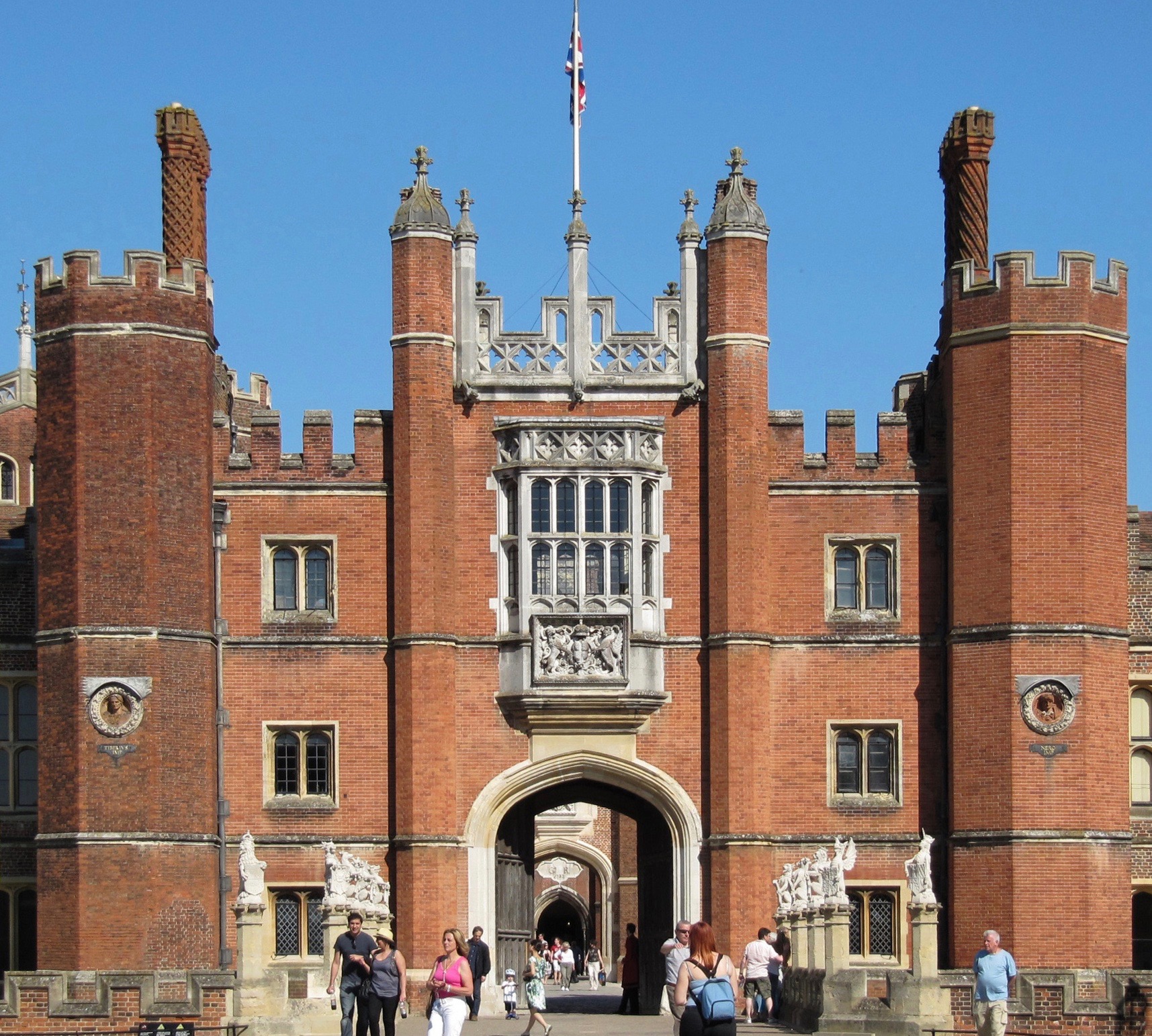
Hampton Court is interesting both historically and architecturally. Built in stages by different owners and kings, it hangs together pretty well.
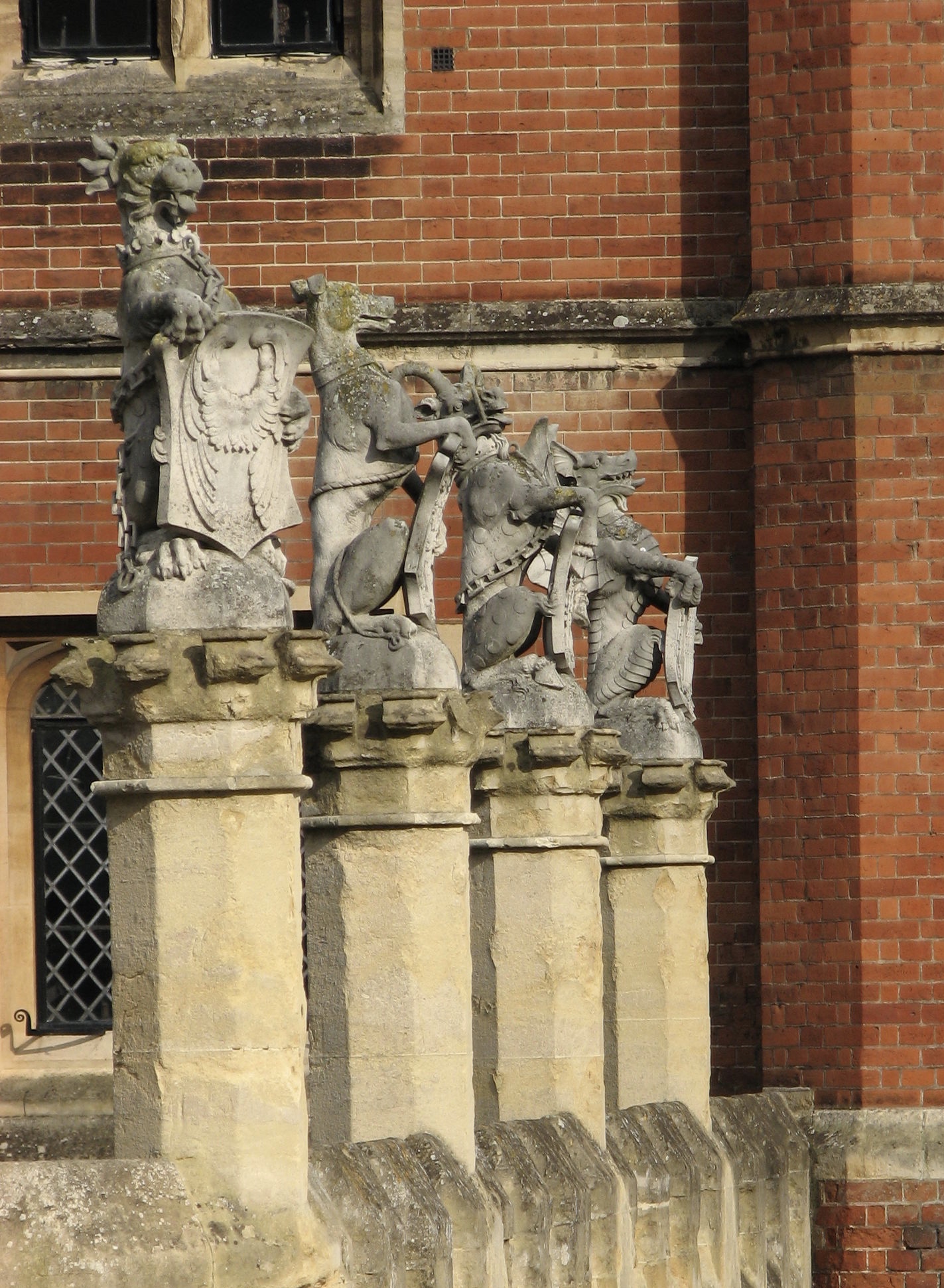
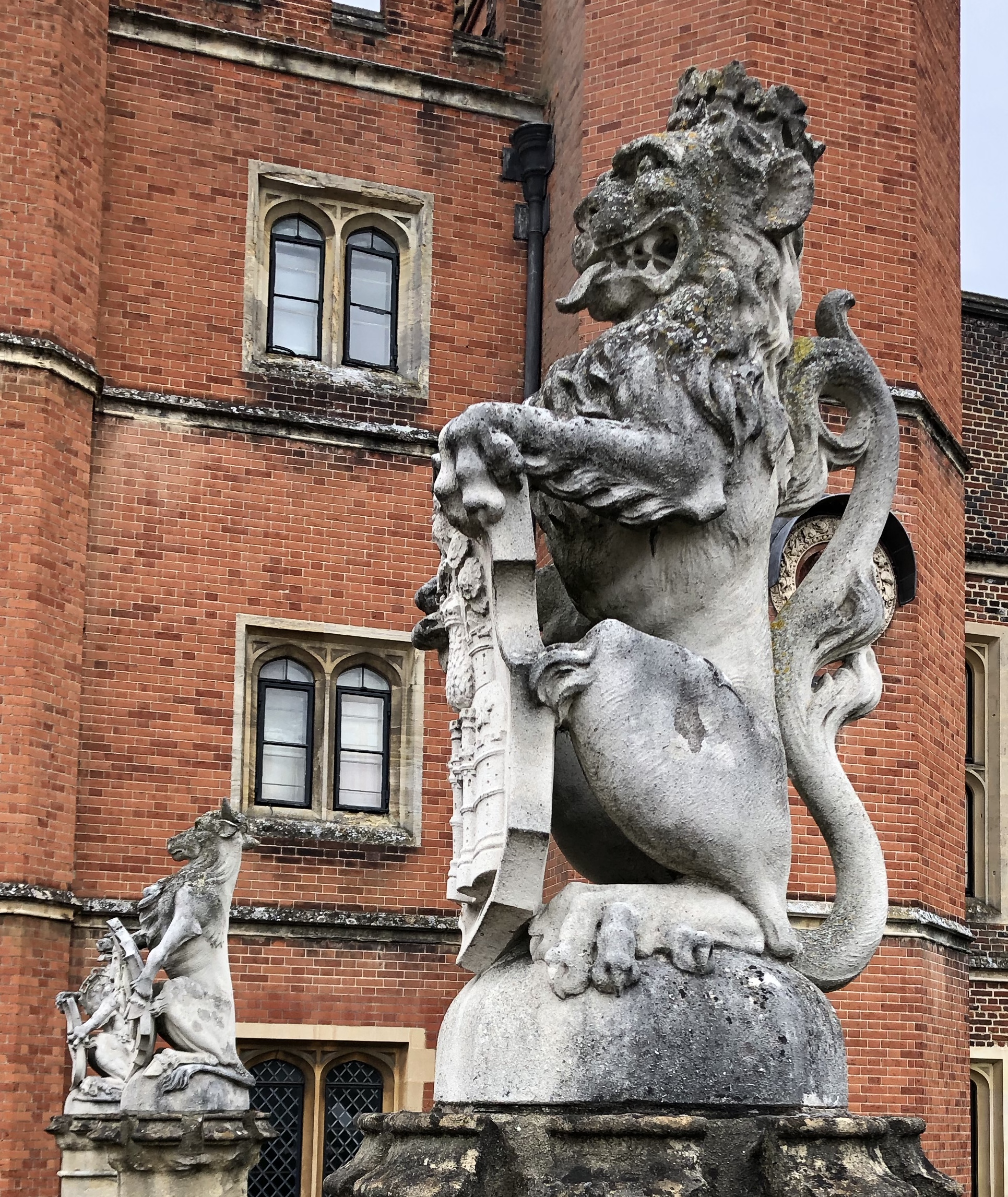
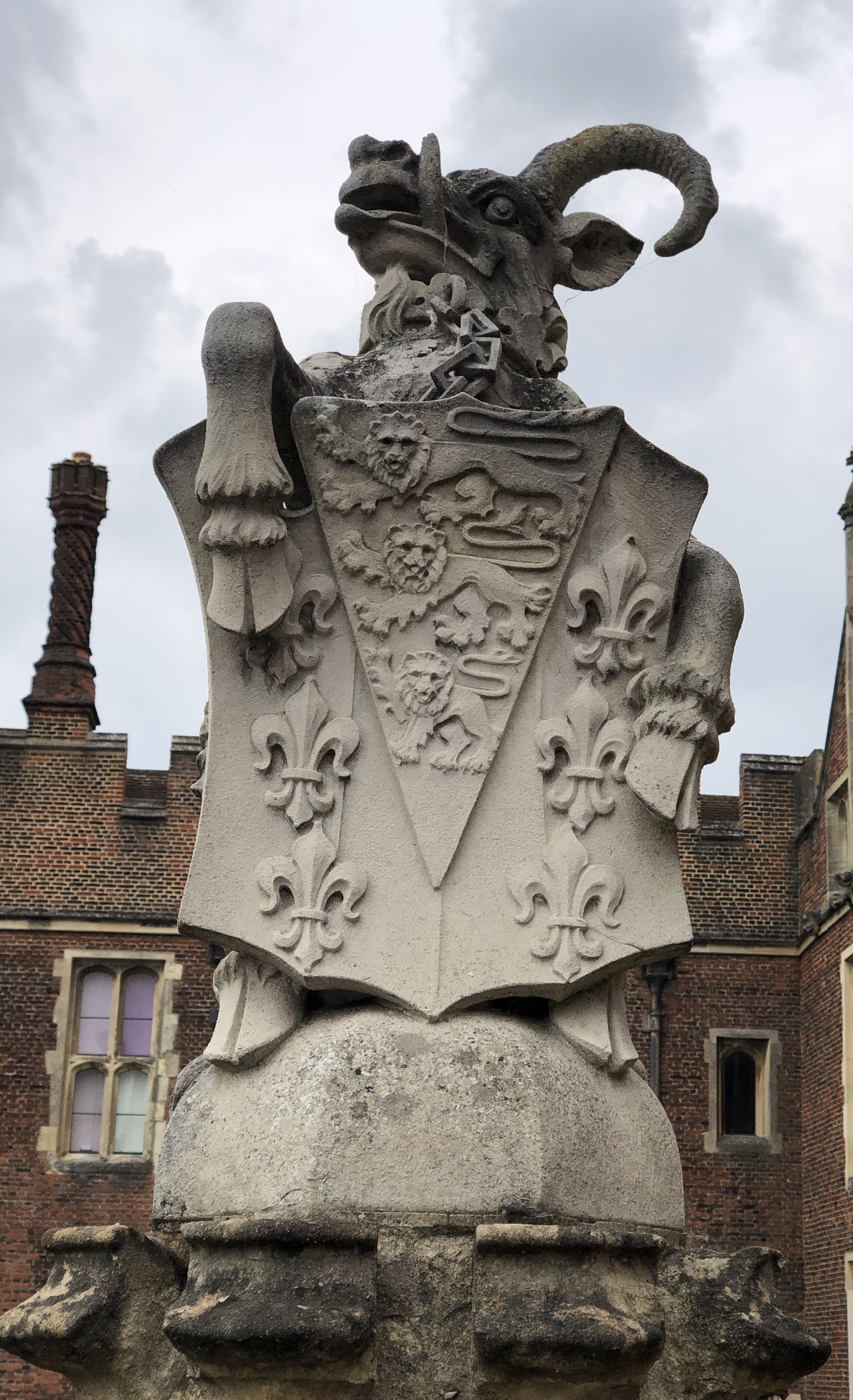
The entrance is guarded by these fearsome creatures holding shields in a decidedly clumsy way. But their scale against the entrance makes them almost charming.
The ceiling of the great hall, where tonnes of roasted meat were consumed by Henry’s friends (some, prior to being killed themselves), is a masterpiece of woodworking. It is probably the most impressive part of the palace, with the possible exceptions of the chapel and the gardens. The part of the palace where Henry took residence is impressive, but cold. By the time George III occupied a different, newer half, the rooms are less impressive, but warmer and more suitable for country life.
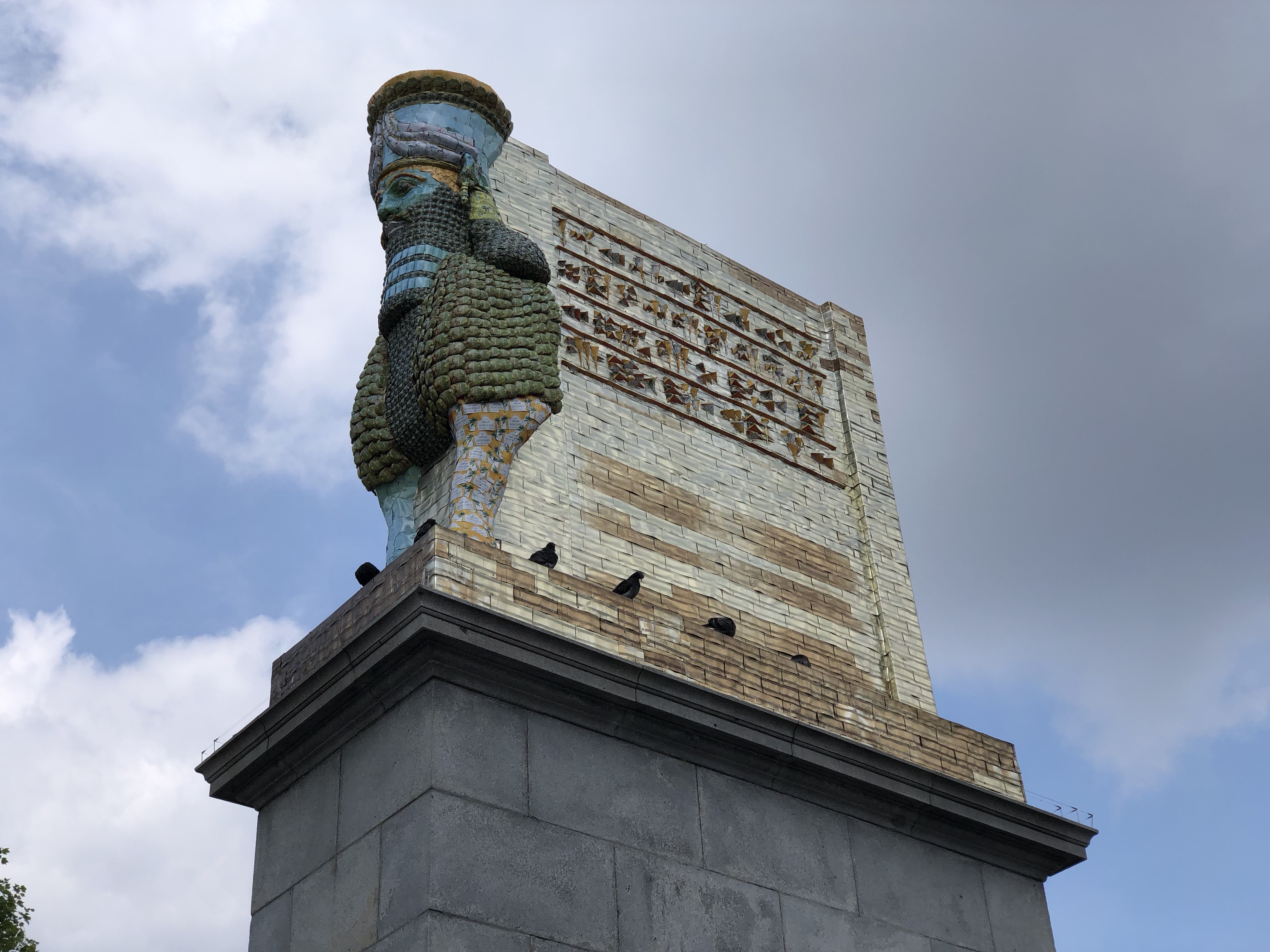
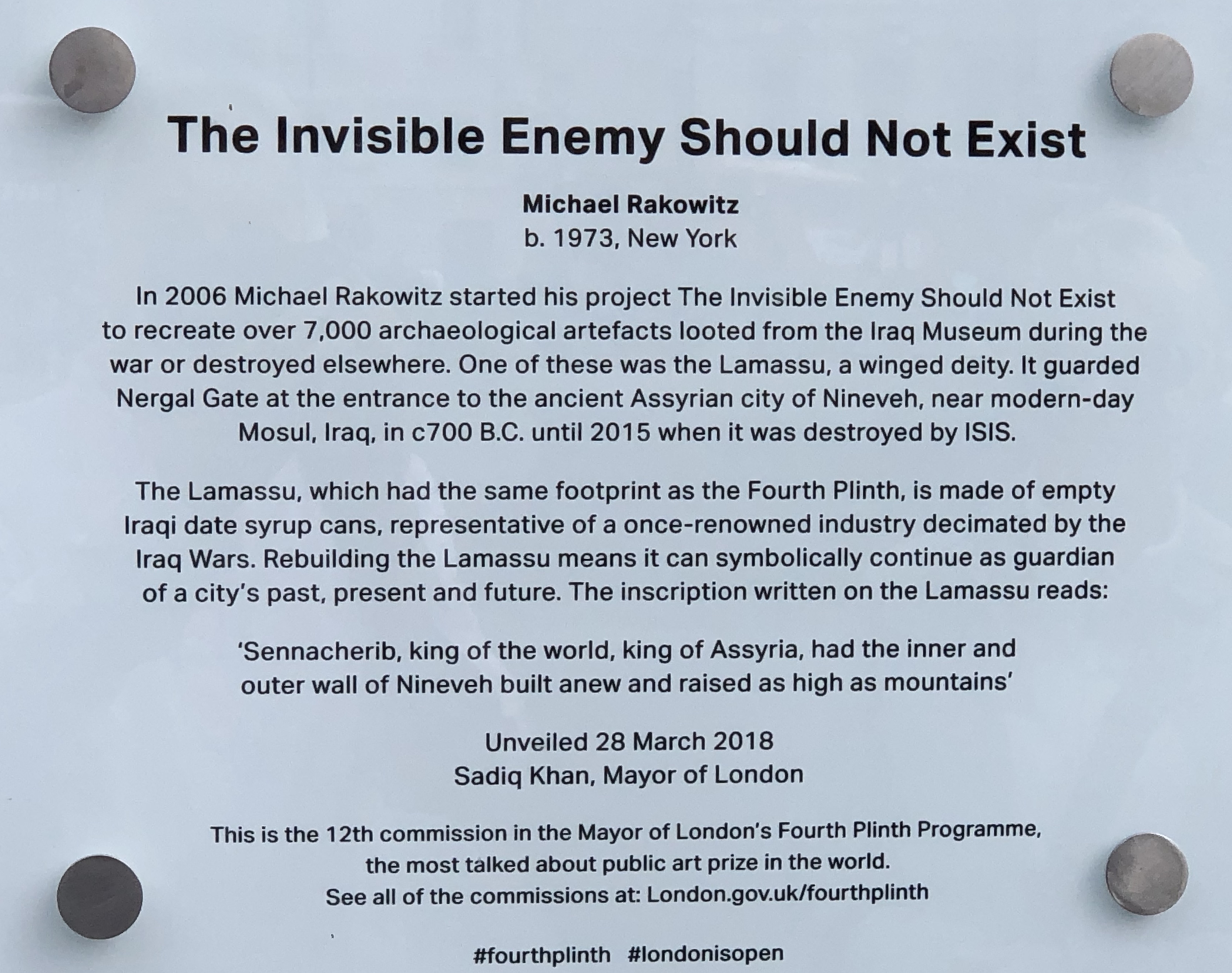
In Trafalgar Square, Mayor Kahn, whom Trump hates and hurled insults at him before visiting London, stands a model of an Assyrian statue destroyed by Isis after our invasion of Iraq. (The inscription above tells more.) I have included a photo of the Canadian embassy on one side of the square because there was a rainbow flag among Canada’s Maple Leaf flags. I infer that this has something to do with Canadian support for an underground railroad rescuing gay men and women from persecution around the world, just as Canada was once a key refuge for escaped slaves from their neighbor to the South.

Our destination in Trafalgar was The National Museum, a must see (and free). Among my favorite things was a class of school children intently forging art in plain sight.
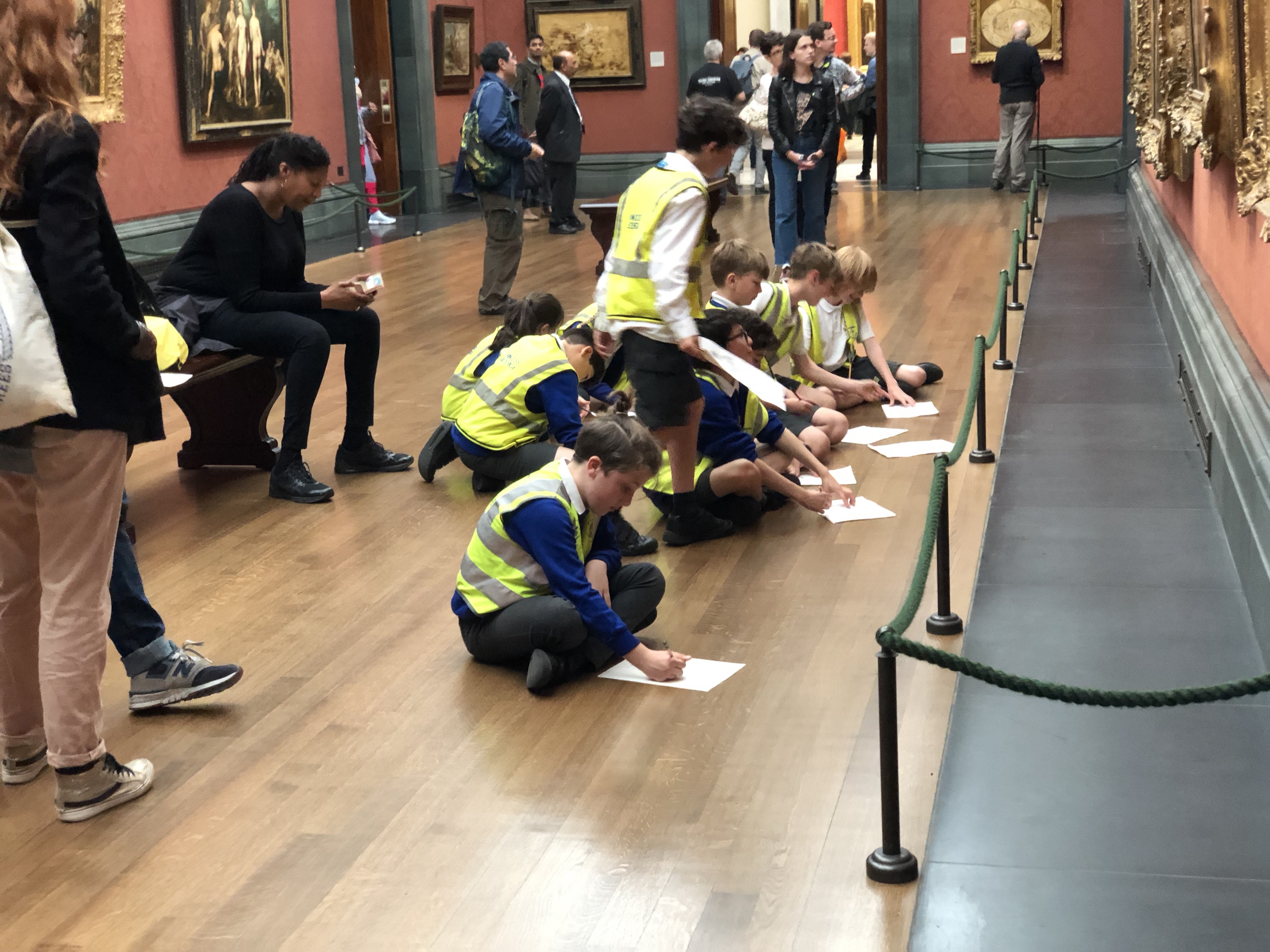
To the right of the children is a nice painting of Jesus raising Lazarus from the dead, but it was neither the artistry nor the miracle that caught my eye—it was the frame!
(The posing boy was inserted to demonstrate the implausible scale.)
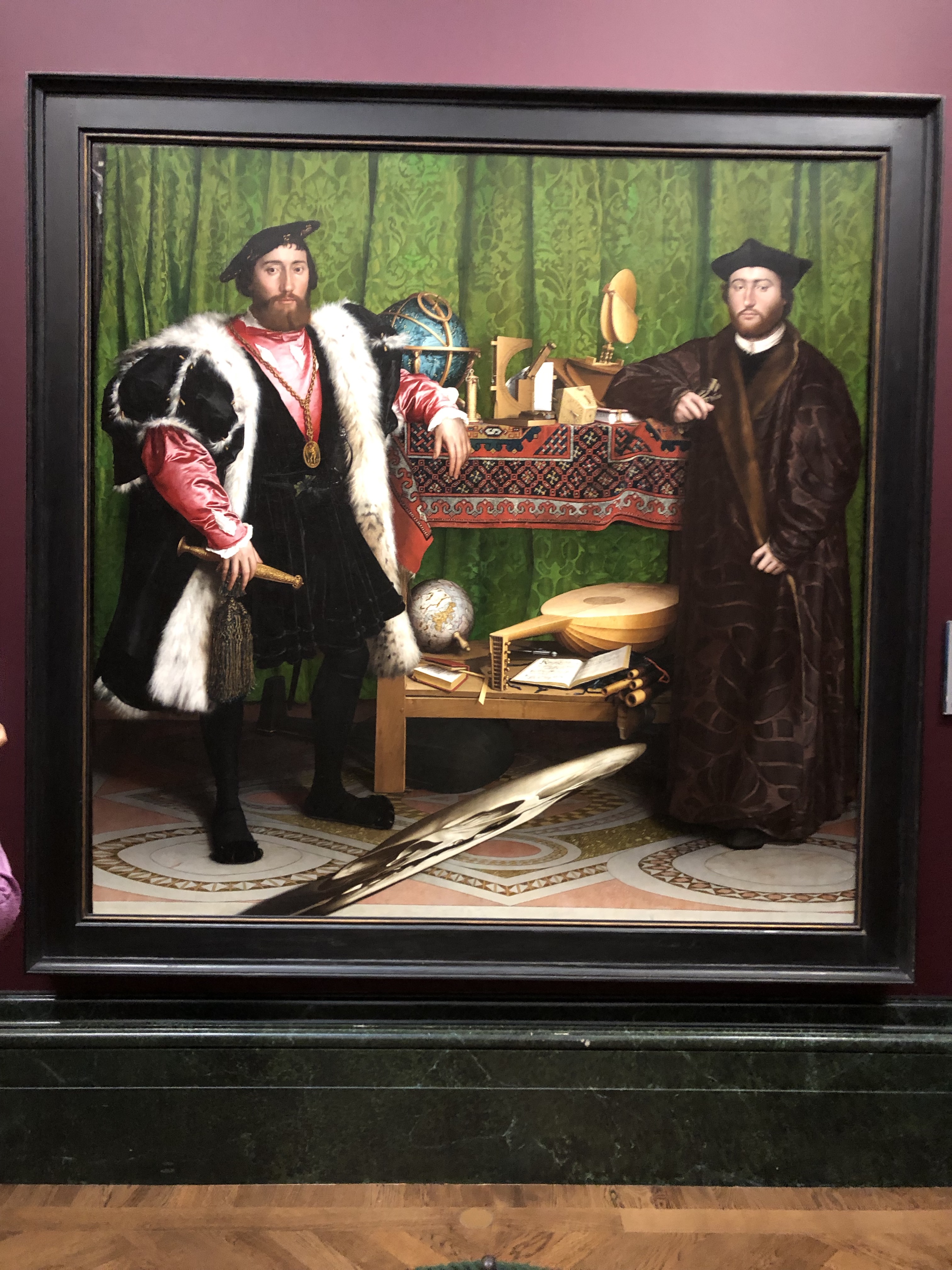
These two photos are of the same painting. You will notice that there is a strange something on the floor between the two men, but from the second angle, it appears to be a human scull. Whether it demonstrates an astronaut entering a black hole or a municipal worker having been careless around a steamroller, I cannot recall.

Carnaby Street

Remember Carnaby Street where all the cool London kids shopped for smart fashion in the 60s? Remember the 60s? Well Carnaby Street has gone a little upscale, but it maintains the small store charm of shops wedged into low, narrow buildings. Today, cars are forbidden. Hurray.
IMG_20190521_185059

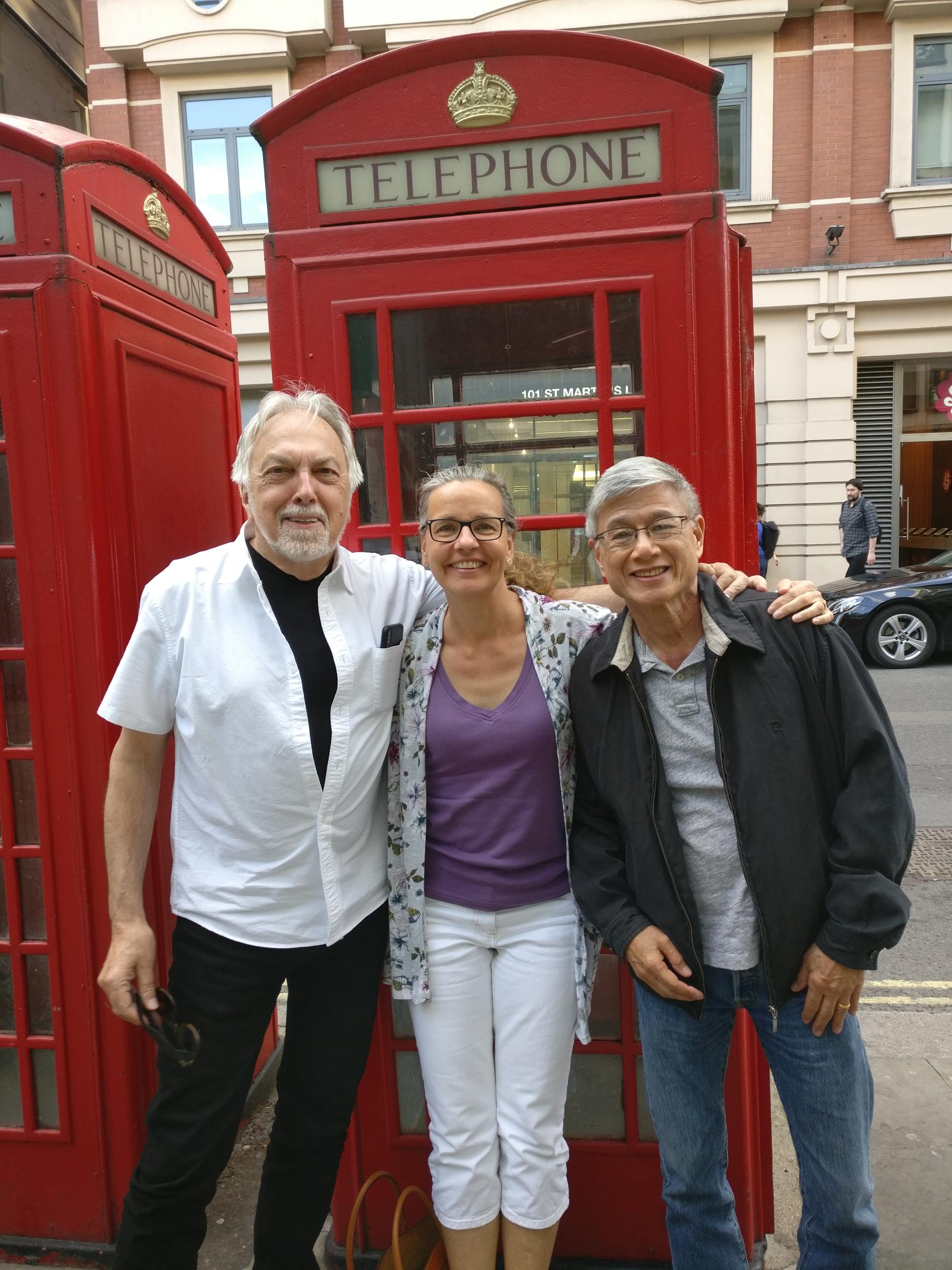
On our last afternoon, we connected with an old friend from PG&E with whom I worked some 26 years ago. She is a British citizen who moved back to London from San Franciso after marrying Mark, someone I have never met. It was wonderful to see her again.

There is so much more of London and surroundings to see that it will be another, shorter trip in the next couple of years. Trains to Oxford, Cambridge, Bath, and Brighton can fill a day here and there. A boat trip to Greenwich to learn about why time is so mean, as I can attest, with the photo above, it is.

If you have read this far, you need to do more with your life, but thanks for listening?

jygXLGLsTdyKtCbacTha2g

Our long trip home was bearable.

Munich 2019

The Flight  A Boeing Dreamliner has one notable advantage over other planes. The windows have no shades. Instead, one can change the glass transparency from clear to opaque in five steps. That turns out to be a particularly cool feature if you have ever been annoyed at one passenger who keeps opening a window shade while others are trying to sleep or watch a movie—the controls can be centrally disabled, foiling a passenger’s attempt to flood the fuselage with bright light. How did I discover this? No comment.

Orderly From the air one can see that Germany is orderly. Farmland on the outskirts of Munich is divided in neat rectangles of varying crops, distinguish only by the different shades of green in adjacent rectangles. Houses are huddled together with charm; sprawl is unknown.

nhxkrngfqcqeyjnymodnpg.jpgFrom the ground, it seems that the roadside vegetation is also well-maintained, but it is easier to discern from the air at what felt like a slower groundspeed. Fortunately, German cars and roads are designed to reduce commute times with white-knuckle effectiveness, carving a 45 minute ride by other standards into a rather thrilling 20 minutes.

L9ozxxDFTS62yRyGs7FJnA

We lodged by one of the ancient gates, a defense that proved useless against the angry allies, technically before my time, but city construction barriers proved less penetrable than pre-flight walls. Barriers flower everywhere, like speed bumps with an effective German insistence. An inviting metro entrance was a fortuitous discovery. The underground is teaming with shops and restaurants lining the wide concourses that lead from generously distanced escalators, providing substantial shelter from the varied Bavarian weather—chill winds and irregular showers in late April. At major stops, one can travel in shelter for two city blocks, oblivious to the construction overhead.

Schlockinspiel  There is little doubt that the Germans have a history of great music (Beethoven, Bach, Brahms, just to mention the Bs) and philosophy (Nietzsche, Schopenhauer, Goethe) but in the fine arts (painting, sculpture, fashion) they lean a little harder on kitsch than inspiration.

IMG_0460

The craftwork is admirable and worthy of compliment, if not sincerity, but how many times do we need to see George slay the dragon? Themes are limited. Lederhosen is to fashion as a sledge hammer is to the sculptor’s chisel.

I concede that I enjoyed both the oompah music and the beer.

You might expect Munich, nestled as it is in Bavarian Prealps (a summit cum laude term), to be a hilly city, but such an expectation would prove you to be as ill informed as I. To keep a good-natured diet of liter beer and pretzels unchallenged, the early settlers of München found a flat spot, modestly elevated above the Isar river. As to my personal favorite, I give it to the pretzels. Beer is taken seriously everywhere, but fresh German pretzels, always with salt, sometime with added cheese, or stuffed with a small salad, or filled with what appeared to be a young goat, are unavailable in San Francisco to my knowledge, though I could do without the goat.

The flat streets make bicycles exceptionally popular. Just as in Amsterdam, the bike paths are a lane in the sidewalks, slightly depressed, giving safety from errant vehicles to riders, but that gain is the pedestrian’s loss.

Whether due to the narrow streets or door widths fixed in leaner times, vegetarian options have sprouted on most menus below the attractive photos of slaughtered pigs. I recounted for Rod the claim that the schnitzel’s wiener is flat and tender because the cooks have to hammer the piss out of it. The apocryphal story is a vegetarian’s revenge.

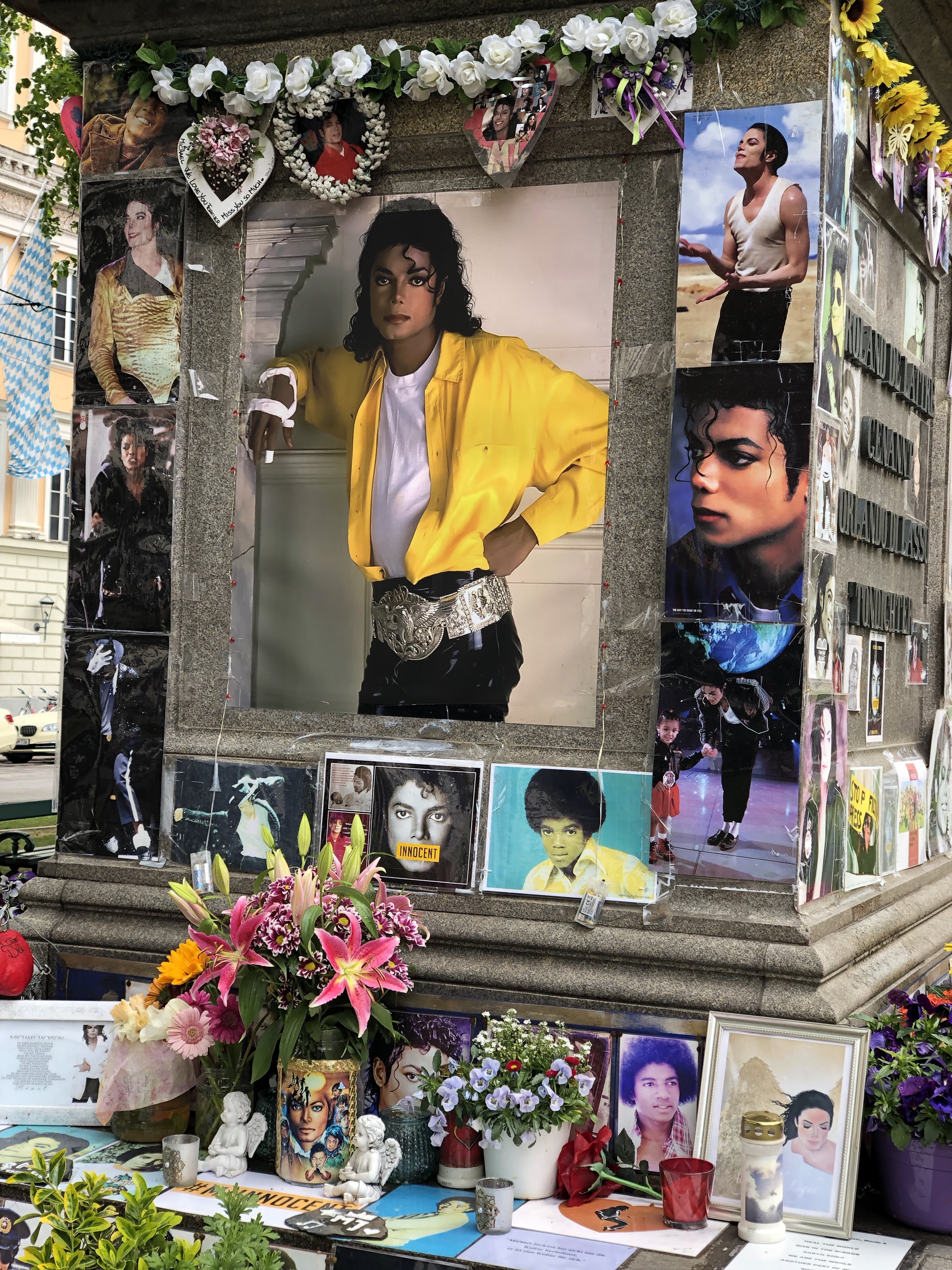
In a small city park, beneath the elevated bronze of the forgotten composer Orlande de Lassus (obviously, not entirely forgotten), the people of Munich have allowed the fans of Michael Jackson to monumentalize their admired singer with a tribute of photos, flowers, and hand-written notes. To HBO watchers, the conviction of someone by profiteers is more convincing than acquittal by a jury of twelve. Perhaps the Germans have seen this movie too many times. Americans have gotten used to the discrediting of of a dead man, like John McCain for instance, by a corporateer, when dead and defenseless.

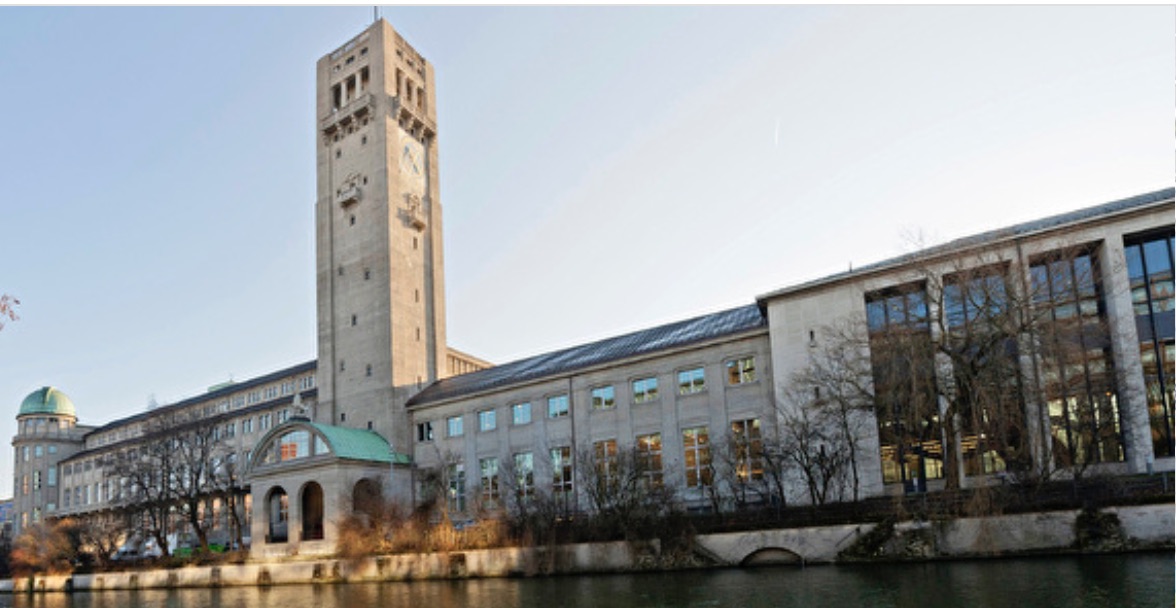
The Deutsches Museum is remarkable in a few ways. First, it is comprehensive in technology and history, from mining to astrophysics. Many things are put into elaborate settings that give a sense of realism to the unfamiliar, particularly mining. The huge museum keeps a wide array of children and adults interested. I liked the windmills, perhaps because they reminded me of being stoned in The Netherlands.

Deutsche Museum

We visited a fine arts museum (see kitsch above) and the Residenz of prior monarchs. Long after they were disposed, the capitulation of the city to allied bombing and pillage left the extensive, rambling palace without much of the original charm, such as it was. The rooms are littered with apologies for inauthentic replicas and make-dos.

We liked Munich enough to forgive its chilly April weather and hope one day to return.

Archaeological Days

There were two sites of archaeological interest on our schedule. The first, a museum, which starts chronicling the history of Sicily from about 300,000,000 years ago, had a display of great interest at the ticket counter. Stephanie and I agreed he was stunning. The whole museum was peppered (if that’s the word) with such students, perhaps working for a stipend as part of their studies. It was interesting to see a fine museum staffed with young people in casual clothing.

The progression of civilization on this large, historically significant island is hard to overstate, but I’ll do my best. Early settlers found flint to be a useful substitute for claws and saber teeth. An enlarged brain provided additional advantage that has since been abandoned by Trump supporters. One witnesses the progress of crude pottery taking on attractive shapes, then colors, then glazes. Attention to detail eventually gets to parts of the human form that assumes an enlarged place in human history.

I have always been curious about the black on terra cot genre that captivated the Greeks to the near exclusion of all else for a huge percentage of their glazed pottery. Has art ever been so lacking iconoclasts? Or did the potters see Prometheus and say, “fuck that.”

Eventually, the Romans dropped by, the roads got better, women are said to have gotten more attention, and anti-intellectualism bloomed in the bloody theatre. Archimedes was stabbed to death by a Roman guard who must have one too many axioms stuck up his ass. Thus, Syracuse declined for a while.

The museum was so large and intriguing that we left the outdoor ruins for another day. As I hope you agree, it was a day well spent.

A day at the actual site of the Greek and Roman ruins is hard to describe, but I have made a questionable attempt with the following video:

My thanks to Mozart for proving the only part of the audio that wears well on the ears. I can see all the flaws in this, but the pursuit of perfection (or even a 6th grade level of competence) would mean that I could never finish this blog.

Thanks to Die Entfuhrung aus den Serail, K. 384, Neville Marriner – Academy of St. Martin in the Fields, for not suing me. (I hope.)

The afternoon lunch, back on the island of Ortigia, was enjoyed in a courtyard restaurant, canopied with grape vines. 

Ortigia, Syracuse

From the start, Syracuse had promise, convenient parking, a hotel along the water front, a room on the 3rd floor (our 4th in the US, as we object to a floor zero) with a balcony, all in a smartly renovated grand building, and warm, sunny weather.

Stephanie had a restaurant recommendation, giving her a mission. We three old men hustled along behind, sheepishly oohing and ahhing at the wrought iron terrace rails, elegant cornices, heavy wooden doors with big knockers, narrow alleys that curve out of tantalizing sight, while she who must be obeyed, map in hand, head high in watch for helpful street signs, led us to one of the most outstanding restaurants in Sicily. We were wise to have followed. (But we would have done so if stupid, too.)

Rod ordered shrimp with tomatoes, while I made the superior choice of fava bean cream with fried salted cod. The shrimp were too lightly cooked for his liking, so we swapped dishes, ¼ eaten. I gesticulated like an Italian (the only thing I can do like an Italian) to make some now-forgotten, cogent observation, cleanly knocking an expensive glass of Sicilian white across the absorbent table cloth. The staff were quick to blot the spill with fine table linen. I ordered a replacement bottle, assuring a long lunch.

The Rogers had a tasting menu of various small dishes. My attention was too preoccupied to record each dish, but I can explain the photos. (ehh, maybe not—”fave bean” is what the menu said)

It was a leisurely lunch. Last to leave, we probably cut into the staff’s siesta or other plans, so an invitation to return remains unexpected. The most expensive meal on our trip, it looked like lots of pizza over the next week…one could do worse. We didn’t.

The Mediterranean tradition of sleeping off one’s lunch alcohol worked well for Rod and me—well, me. Rick and Stephanie explored more of the city; Rick demonstrating a humiliating resistance to early retirement.

In the evening, we found the streets buzzing with excitement. This was the Saturday night before the start of school’s fall session. Half the crowd was under 25—the better looking half.

Italian youth rarely raise their voices when gathered. It seems like respect for elders, but I doubt that they even see us—we move like trees—but they do not draw attention to themselves among their friends. Americans pride ourselves on individualism and find lots to appreciate in that, putting celebrity and wealth above family and friends. Europeans value community, which gives them healthcare, free college, and gun control. We have Facebook and Donald Trump; they have slim bodies and stylish clothes. Tough choice.

A couple of young lads, perhaps 12 or 14, were briskly walking up a broad, pedestrian street when one spotted a couple of friends his age. He pulled his companion over to greet them, kissed each friend lightly on both cheeks, introduce his friend, who shook hands. That seemed so foreign to me, but perhaps it is harder to punch or to shoot someone you have just kissed. That has always been that case for me.

We met an artist with an exhibit at a huge gallery (old, empty church). We were his last admirers of the day, but he spent time with us explaining his work while pacifying his infant son. Rick and Stephanie bought a stunning canvas from him. I took a photo of an engaging Greek subject, as is my wont—want?

THE CENTRE POMPIDOU

Image

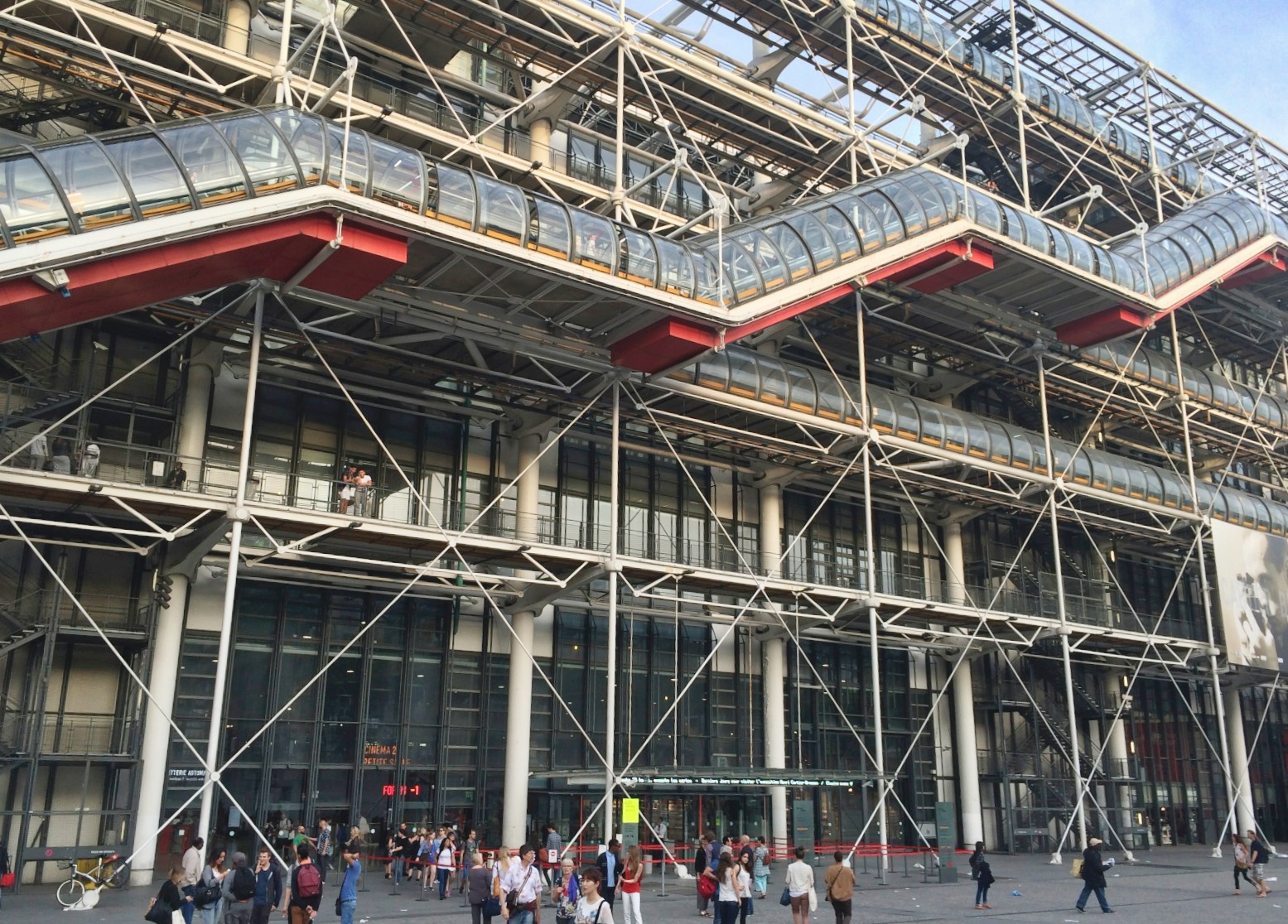
Perhaps we are supposed to see this structure like a fake mole on an actress’s blemish-free complexion. Buildings great and modest sport some form of refinement—from mansard crowns to iron balustrades guarding French doors down to the brass knockers on 12′ oaken portals—throughout the central  arrondissements municipal that comprise walkable Paris. The beloved Centre Pompidou is a notable exception. It resembles not so much a skeleton as a living body with the skin surgically removed. Ventilation shafts, plumbing, electrical conduit, and the columns and bracketing that hold the glass partitions and flooring in place are thoroughly exposed. It sparks the engineering curiosity of precocious children who can analyze the cause of the escalator failures here and there.

HDRtist HDR - http://www.ohanaware.com/hdrtist/

Though I found the space uninviting and confusing—get there early so that you can play “find the entrance,”—the modern art collection is unexpectedly spectacular. I offer two of my favorites:

Pompidou 1  The daily sacrament.

Pompidou 2 You missed me.

The Louvre

It’s big and has lots of art. ‘nough said ’bout that. One has to limit oneself to a few periods and accept that this museum is hard for the curator to master; a visitor has no chance. It spans from antiquity to the the point in time when the Paris art world rejected Impressionism, and if there is anything in it from Impressionism and beyond, I know not of it.

My favorite sculpture, aside of course from all the naked men in marble, is this piece in which the sculptor maded stone transparent:

How one sees through the stone veil to the face below is a mystery, but then all sculpture seems impossible to me. If someone were to write without a backspace key, I’d be shocked. So how to sculpt a hand without loping off a finger is beyond my comprehension—which leaves me to wonder how many male models complained, “Hey Mike, my dick’s bigger than that,” when the artist was careless with his chisel near the upper thigh.

We found a character from the Flemish period who is a spitting image of Matt Damon.

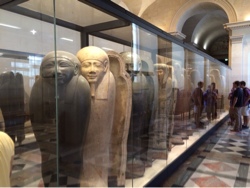
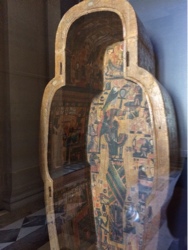
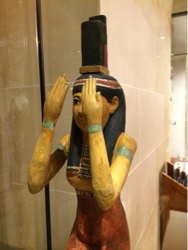
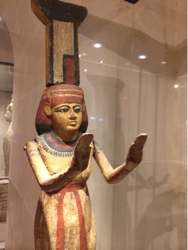
I learned the most from the Egyptian exhibits. For instance, poor pharaohs could buy off-the-rack sarcophagi. And some were equipped with late night reading, but the bandages probably got in the way. Egyptian mothers invented peek-a-boo, and I can now tell me lawyer friends that the original expression was “long arms of the mother-in-law.”