Palermo

Image

The city layout of Palermo is what Shanghai should have been, a wide grid of smart boulevards enclosing neighborhoods that have, except for an ineffective dollop of asphalt, changed little in 100 years. I know this involuntarily from a premature left turn that Rick made when his navigator misread our map while seeking our classy hotel. We miraculously wound our way to the Palermo Cathedral, where Via Vittorio Emanuele, our hotel’s street, was closed to auto traffic. Our persistent navigator pleaded our case to a helpful traffic cop who allowed Rick to drive down the street with the unnecessary caution (one hopes) don’t hit anyone. (OK, she only spoke Italian, so how would I know? But that’s the Italian driving rule, no hit, no foul.)

As always, images will enlarge if clicked on.

We did a rapid check-in to drop off our luggage before returning the car about a mile away, allowing us to enjoy a sunny Friday afternoon stroll up the Via Maqueda, which on our return was also closed. Palermo is a city for people, not cars, and Friday is party day. The people are purposefully dressed for social social interactions.

To illustrate the resistance of Palermo to the demands of modern life, I took a short video of an intersection behind the Cathedral during a late-night celebration. This nest of capillaries is fed from the wide arteries of city planning. When driving around the city, stay on the broad streets as long as possible; the capillaries are not for American cArpuscles.

American movie entertainment, like The Godfather, gives one an impression of crime bosses, pickpockets, and corruption. Instead, I saw smiling faces, calm, sincere, handsome. On our walk from the jeep drop-off, quenched by a negroni cocktail, smiling under the crystal blue sky, my street gawking was well-served by a red traffic light. A group of teens, perhaps between high school and college patiently held the curb in easy going chatter when one outstandingly attractive young woman turned to give me a warm, curious glance at an obvious tourist costumed by Palermo as if at a ball. I smiled; so did she. I mouthed the words,”very pretty,” with a simple nod. She mouthed back, in posed English, “Thank you.” The light changed. We moved on in our separate clusters, my afternoon improved by her payment to my charm deficit … a tiny bit.

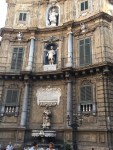
At the intersection of Via Maqueda and Via Vittorio Emanuele, a few steps from our hotel, is an intersection misnamed Quattro Canti, which translates to “four corners.” In fact, there are no corners because the intersection is a circle. Even the buildings are curved to deprive any place for a corner to hide. Each building represents a season (only summer and winter are depicted below), four kings, four patrons, and the four cheeses on a quattro formaggi pizza. (The last item is a guess, but all the statues represent someone known as a “big cheese.” Such is my improved Italian.) The first two photos below are of Quattro Canti.

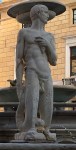
Just around the corner (around the circle?) is the Fontana Pretoria where some nuns got a deal on a fountain and a clutch of naked statues. It came to be called the Piazza della Vergogna, the “Square of Shame.” The shame, it seems to me, is to have lived within modest reach of such depictions while never touching the real thing.
Shame or not, the carvings stand tall, if not erect. (Reminds me of a story an uncle once told of a racy play he saw seated in front of two church ladies who tisk’ed and condemned the on-stage pruriency, but sat until the final curtain.)

Once a religious city (in Europe, only the Vatican can claim to be stedfast), Palermo has a couple of outstanding efforts to get the attention of He who is not there.

fullsizeoutput_1b3b

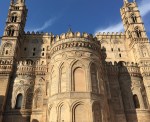
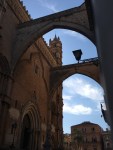
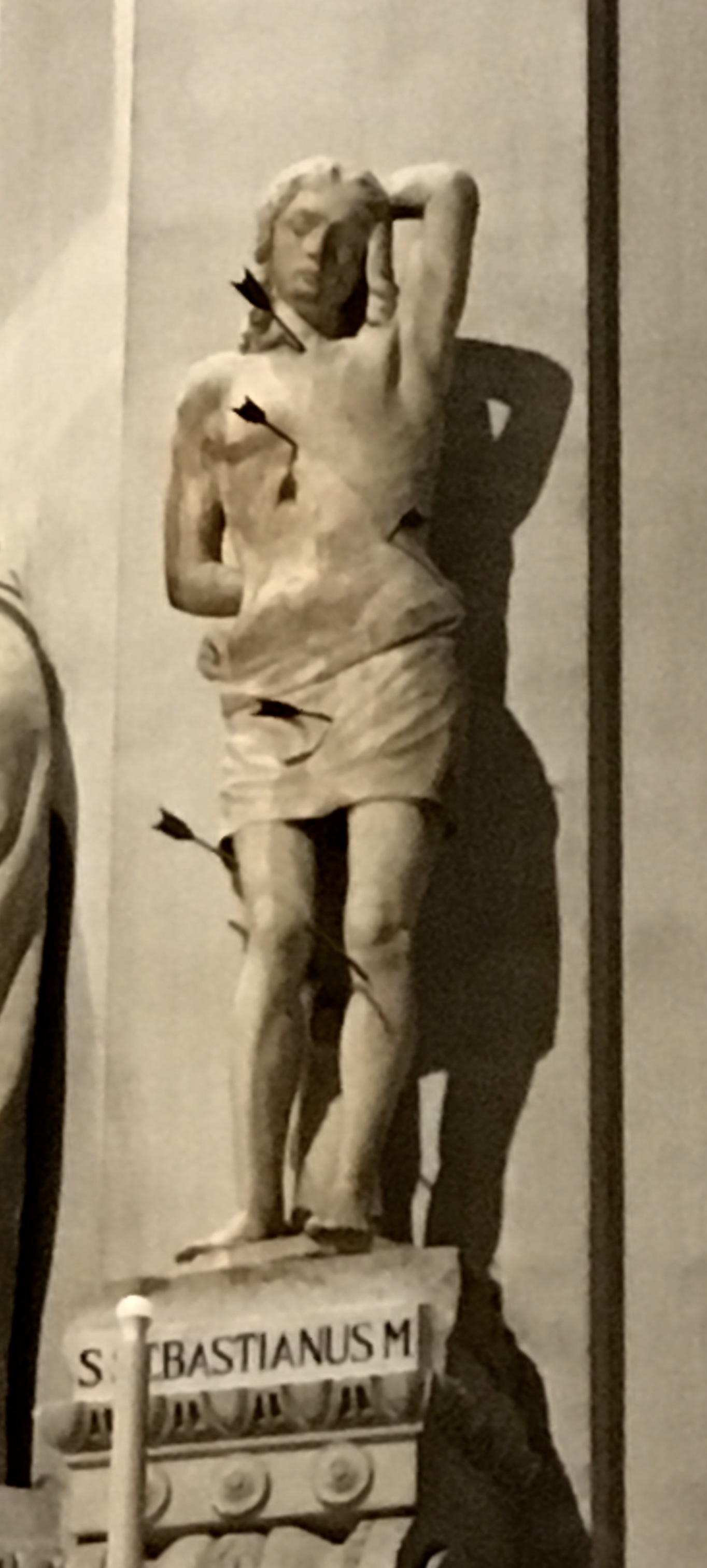
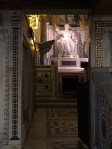
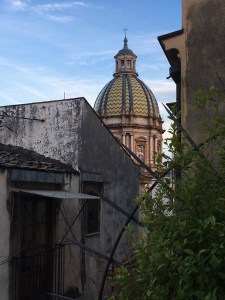
Palermo’s Cathedral resembles a cluster of buildings more than a unified structure. A brilliant architect made the collection warm, proud, inviting, and harmonious. With the exception of a statue of St. Sebastian, depricted with an arrow (enforcing the mafia code of silence), this is a church that fits the purpose of a city, rather than standing apart and above it.

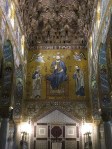
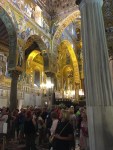
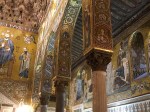
Stephanie put the Cappella Palatina on our list of must sees. There is no escaping the long lines, but a visit to Palermo without seeing this Byzantine chapel built by Roger II of Sicily in 1132 is unthinkable. The mosaic detail covers every square inch of the surface. (An Italian named “Roger,” really? And there were two?)


There are many other things to see in the Norman Royal Palace of Palermo that contains the Cappella, but photographs are forbidden outside the Chapel, and so with the vision of Sebastian fresh in my mind, my camera stayed protectively in my pants. The palace houses the legislative chamber of Sicily’s elected body, showing a desire to maintain local control as strong in Sicily as England, Tibet, and North Dakota.

If I were ever to return to Sicily, Palermo is a place I would stay for several nights. Perhaps what I like most is the sense that Palermo is a city complete. Cranes do not tower above the street life, in some frantic demand that something is needed to correct a bygone miscalculation. The city seems at peace with itself—justifiably. Construction suggests dissatisfaction. The desire to create a better future is often seen as optimism, but at its core, there is displeasure. Palermo has none of that. Modernity is a visitor who knows her place.

And that is our visit to Italy in 2016. Now home to watch Donald Trump become president. I shall never again criticize the Italians for voting for Berlusconi.

The Isle of Lipari

Lipari is a popular island among tourists, but it does not have the crush of shoppers who waddle the spick and sparkle lanes of Capris. Stephanie had this on her personal agenda because her grandfather was imprisoned here (house arrest) by Mussolini for unacceptable political beliefs. It falls short of the standards we set with Alcatraz or Rikers, where we house teenagers, presumed innocent, awaiting trial. Of course, Benito did not feed them; that was the responsibility of a family on the mainland that had lost its pasta winner.

I have made only occasional mention of our hotels, most of which we loved, but this one has interest beyond its breakfast buffet and clean hallways.

This place has tchotchkes everywhere. The outdoor garden is serene; a great place to read a book or catch up on a blog, which obviously, I did not.

Our first excursion took us to a simple restaurant on the main street of this two-street town. Once again, the food was surprisingly great.

San Francisco should have so many variations on spaghetti, like this one with crushed anchovy dressing. The calamari was rolled around a seafood stuffing and grilled perfectly. Rod’s fries and tomatoes were served separate from the swordfish, as if the tools to eat the steak might require room to plan an attack. The required effort was less than modest.

Rick and Stephanie booked a sail to a volcano and a couple of nearby islands for the following day, but Rod and I had been traveling for 24 days, so the lure of our hotel’s peaceful garden was too great. We stayed on Lipari.

Before their ship sailed, the group got to do a morning museum tour.

Rick and I speculated about the shape of amphora vessels, which to our sensibilities seem awkward. They are fashioned to a pointed bottom, which makes for a long carry home from Delta Kappa Groceries if you cannot set it down. But I know why they were manufactured this way.

After the boat took our travel-mates away, we strolled the narrow, non-commercial streets off the second port. These sun drenched simple homes, with murals bleached into tasteful obscurity, were the confines of Italians serving house arrest. Maybe Sing Sing will one day be a fashionable co-op, but I don’t see it.

There is not much to say about these photos (above), but I thought they captured the happy dignity of people whose place on the earth seems remote. I doubt that many would live anywhere else in the world. There is something relaxing about an island. It brings to mind a passage from Shaw’s play, Man and Superman, from an encounter in hell:

No, no, no, my child: do not pray. If you do, you will throw away the main advantage of this place. Written over the gate here are the words “Leave every hope behind, ye who enter.” Only think what a relief that is! For what is hope? A form of moral responsibility. Here there is no hope, and consequently no duty, no work, nothing to be gained by praying, nothing to be lost by doing what you like. Hell, in short, is a place where you have nothing to do but amuse yourself.” 

And so island life seems to me.

We settled at a marvelous restaurant on the slope of an ancient street. Seated beside a young Brit couple, Harry and Lidia, the conversation was entertaining, about Brexit, Trump, and a dozen other, less consequential things.

I finished off a marvelous Sicilian Cabernet, Rod contributing almost nothing to the effort, while we shared gnocchi with clams, Rod had pork with almonds, figs, and red onions. I ordered an artisanal green pasta with shrimp. We split a huge bowl of fresh fruit. The restaurant owner was justly proud of this establishment as was his wife, who does all the cooking. They seemed satisfied with life. Though we had dined outside, I made it a point to find the cook and express our appreciation to her beaming face and square shoulders.

You oughta see her carry wood!
I tal you w’at, eet do you good.”  from a poem by T.A. Daly

Rick and Stephanie wandered by, having finished their boat trip, and ate at the same restaurant, but at a different table.

The hour was late, the night warm, the moon was full and so were we.

Linguaglossa & Taormina

The drive to Linguaglossa (our only AirB&B stop) was almost uneventful, save the troublesome stops at a couple of toll booths, used by Sicilians to support a depressing socialism, with welfare, obscenely long vacations, childcare, and low crime. Takers! But I digress—as we did on the last kilometer (the American word “mile” is shorter…ha ha ha) trying to find the street listed, deceptively, as our destination. Rick navigated the narrow turns that took us around the target a few times until, by astounding serendipity, Stephanie saw a faded scrawl on the side of a building that could have been graffiti but was in fact our street paved path. This passage was easy to miss—as likely to have been a wide doorway as street, meandered 100 meters uphill, its ungenerous girth regularly narrowed by a pipe or wire on a building. There were, need I say, no sidewalks.

We squandered 30 minutes or so trying to rouse our host or disturb a neighbor enough to pry a free hint as to where to put our bags when a smiling refugee on a bicycle greeted us with limited Italian and no English, coaxing us to follow him to the “House of Stone.” He rode charitably slow, given how easy it is to negotiate streets on a 2-wheeled vehicle—no fair. Nice place, though.

If only all towns had streets as Bertha-wide as the driveway. This view, featured on the AirB&B web site, is not visible from the listed address, on the street below. (The owner should consult for treasure-hunt apps on iPhones.) Basta with the complaints already.

Our spirits undampened by frustration or occasional sprinkles, we set off for the 15 km drive to Taormina, which missing would have been a grievous error.

The popular tourist town is owed another visit, as we did not get down to the beach, at least 100 meters below, or to the castle, a couple hundred meters above. If ever I take a Mediterranean cruise (when I am much older), Taormina must be on the itinerary. Spending a week on its beach is looking more attractive all the time. Lie in the morning sun, hike to the town for lunch, ask the local girls to braid my hair…what is left of it.

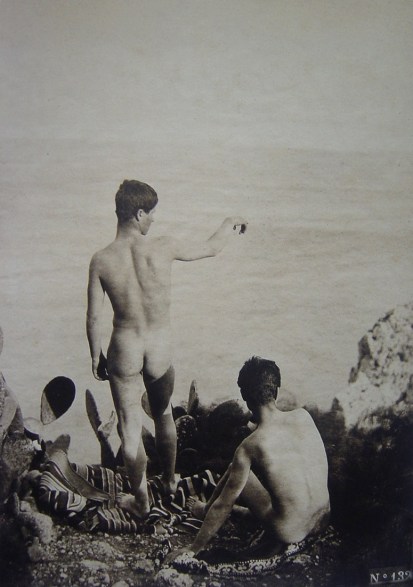
image-10-10-16-at-1-14-pmThe town’s fame has been enhanced by the work of the German photographer, Wilhelm von Gloeden, who photographed many nudes, mostly male, in the early 20th century. Today, he could spend three life sentences in an American prison for having models who were younger than 18, though in Europe, he’s considered an artist.
Gloeden lived most of his life in Taormina, which can be considered a tribute to his good taste…as is his choice of subjects [in my homo opinion].


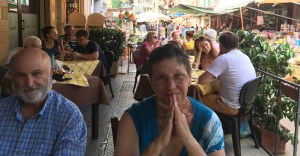
Before we found the primary tourist street inside the town’s walls, we lighted upon a perfectly acceptable outdoor place to lunch with a delicious rosé wine. In Italy, even simple meals are served with care. I saw no fast food in Taormina…or almost anywhere else in Sicily. Fast food in Italy is a stop by the gelato shop on a hot afternoon, not a meal. Meals are fleeting joys, like full moons, to be enjoyed whenever possible. How did Americans come to believe that a chance to sit with friends over a casual repast and conversation is something to be rushed, like the incongruous oxymoron “fast food”?

I am determined to climb to this castle one day. (Better be quick about it.) There is a spectacular Greek theatre on a lesser hill, which we did not visit for lack of time (lines of tourists). A week here, with time invested on a sandy beach, would barely be adequate.

img_0816


Archaeological Days

There were two sites of archaeological interest on our schedule. The first, a museum, which starts chronicling the history of Sicily from about 300,000,000 years ago, had a display of great interest at the ticket counter. Stephanie and I agreed he was stunning. The whole museum was peppered (if that’s the word) with such students, perhaps working for a stipend as part of their studies. It was interesting to see a fine museum staffed with young people in casual clothing.

The progression of civilization on this large, historically significant island is hard to overstate, but I’ll do my best. Early settlers found flint to be a useful substitute for claws and saber teeth. An enlarged brain provided additional advantage that has since been abandoned by Trump supporters. One witnesses the progress of crude pottery taking on attractive shapes, then colors, then glazes. Attention to detail eventually gets to parts of the human form that assumes an enlarged place in human history.

I have always been curious about the black on terra cot genre that captivated the Greeks to the near exclusion of all else for a huge percentage of their glazed pottery. Has art ever been so lacking iconoclasts? Or did the potters see Prometheus and say, “fuck that.”

Eventually, the Romans dropped by, the roads got better, women are said to have gotten more attention, and anti-intellectualism bloomed in the bloody theatre. Archimedes was stabbed to death by a Roman guard who must have one too many axioms stuck up his ass. Thus, Syracuse declined for a while.

The museum was so large and intriguing that we left the outdoor ruins for another day. As I hope you agree, it was a day well spent.

A day at the actual site of the Greek and Roman ruins is hard to describe, but I have made a questionable attempt with the following video:

My thanks to Mozart for proving the only part of the audio that wears well on the ears. I can see all the flaws in this, but the pursuit of perfection (or even a 6th grade level of competence) would mean that I could never finish this blog.

Thanks to Die Entfuhrung aus den Serail, K. 384, Neville Marriner – Academy of St. Martin in the Fields, for not suing me. (I hope.)

The afternoon lunch, back on the island of Ortigia, was enjoyed in a courtyard restaurant, canopied with grape vines. 

Ortigia, Syracuse

From the start, Syracuse had promise, convenient parking, a hotel along the water front, a room on the 3rd floor (our 4th in the US, as we object to a floor zero) with a balcony, all in a smartly renovated grand building, and warm, sunny weather.

Stephanie had a restaurant recommendation, giving her a mission. We three old men hustled along behind, sheepishly oohing and ahhing at the wrought iron terrace rails, elegant cornices, heavy wooden doors with big knockers, narrow alleys that curve out of tantalizing sight, while she who must be obeyed, map in hand, head high in watch for helpful street signs, led us to one of the most outstanding restaurants in Sicily. We were wise to have followed. (But we would have done so if stupid, too.)

Rod ordered shrimp with tomatoes, while I made the superior choice of fava bean cream with fried salted cod. The shrimp were too lightly cooked for his liking, so we swapped dishes, ¼ eaten. I gesticulated like an Italian (the only thing I can do like an Italian) to make some now-forgotten, cogent observation, cleanly knocking an expensive glass of Sicilian white across the absorbent table cloth. The staff were quick to blot the spill with fine table linen. I ordered a replacement bottle, assuring a long lunch.

The Rogers had a tasting menu of various small dishes. My attention was too preoccupied to record each dish, but I can explain the photos. (ehh, maybe not—”fave bean” is what the menu said)

It was a leisurely lunch. Last to leave, we probably cut into the staff’s siesta or other plans, so an invitation to return remains unexpected. The most expensive meal on our trip, it looked like lots of pizza over the next week…one could do worse. We didn’t.

The Mediterranean tradition of sleeping off one’s lunch alcohol worked well for Rod and me—well, me. Rick and Stephanie explored more of the city; Rick demonstrating a humiliating resistance to early retirement.

In the evening, we found the streets buzzing with excitement. This was the Saturday night before the start of school’s fall session. Half the crowd was under 25—the better looking half.

Italian youth rarely raise their voices when gathered. It seems like respect for elders, but I doubt that they even see us—we move like trees—but they do not draw attention to themselves among their friends. Americans pride ourselves on individualism and find lots to appreciate in that, putting celebrity and wealth above family and friends. Europeans value community, which gives them healthcare, free college, and gun control. We have Facebook and Donald Trump; they have slim bodies and stylish clothes. Tough choice.

A couple of young lads, perhaps 12 or 14, were briskly walking up a broad, pedestrian street when one spotted a couple of friends his age. He pulled his companion over to greet them, kissed each friend lightly on both cheeks, introduce his friend, who shook hands. That seemed so foreign to me, but perhaps it is harder to punch or to shoot someone you have just kissed. That has always been that case for me.

We met an artist with an exhibit at a huge gallery (old, empty church). We were his last admirers of the day, but he spent time with us explaining his work while pacifying his infant son. Rick and Stephanie bought a stunning canvas from him. I took a photo of an engaging Greek subject, as is my wont—want?

Sicily

Our automotive tribulations had not ended. We left for Naples airport in the wee hours for a 6:55 flight. We should have been amply early, but when we neared the airport, a snobby voice announced, “You have arrived at your destination.” Our location was a dark underpass with nothing in sight. The GPS then led us…blah blah blah…after a quick scan through security, we ran to the gate to find that our plane had just pushed away, resulting in a 12-hour wait for the next direct flight to Palermo.

The Naples airport is like any other with 85˚ air, screaming children, hard seats, and limited wifi (4 hours max). I used a cheap pen and tiny notebook to complete the last two blog entries. Nothing is going to spoil this trip. [Just wait to you see the roads in Sicily!]

Stephanie and Rick were good sports about the missed connection and returned from Castellammare del Golfo to the Palermo airport to retrieve us at night. After checking into our beach hotel, we found an outdoor restaurant on the sand, with a warm breeze, a cold wine, and a buxom waitress with weak English and strong opinions as to what we should eat. I obeyed.

The bruschetta was outstanding as was the local wine. Though we had sat down famished, the heaping plate of busiata, a Sicilian pasta wrapped in curls tighter than the young Shirley Temple’s hair was far more than I could eat, sending back to the kitchen a mound of food that could still feed two hungry adults. Perhaps it did. Hope so.

There are no pictures of this feast as Rod and I were busy pretending that all the inconvenience of the day was an adventure we will treasure for years, rather than an ordeal deserving a cyanide capsule.

Rod had decided before deplaning that Rick would do most of the driving—and all of the driving to be done from the seat behind the steering wheel. No protesta. We left in the morning for Selinunte, a site of Greek ruins that appealed to me for what I hoped would be a flattering personal comparison.

These few photos are reasonable examples of typical Greek ruins without the statuary immodesty that intimidates. Left are the stones not carted away by marauding architects from the successive dim ages, each tearring down the last, both theologically and structurally. The most effective Siva is the quake, toppling pillars like Steve Smolen does bowling pins. (But without the masculine pretense.)

After a rest, we ate at a fine restaurant a short walk from the hotel. One must have a destination for dinner to prevent being stopped by, usually handsome, restaurant barkers luring the undecided into mediocrity. Stephanie with her gregarious Italian, always manages to ferret out quality. Sometimes in doing so, she makes a life-long friend. In this case, it was a dinner-long friend, who made all conversation bilingual.