Avignon

Sometime after the end of the 13th century, the pope became squeamish about the unpleasant demise of 40 or so of his predecessors and this led, in ways I will not go into ('cause I haven't a clue), to a cluster of French Popes with a love of big buildings and good wine.

The pope's place at night.


The pope's bridge gets you halfway across the Rhône, from there, Jesus walked, or so the story goes, or so my story goes.

Avignon is a moderate size city in the heart of Provence and the place where we established home base for our exploration of the sights, cities, and hill towns to which this blog is devoted. The old city has an impressive wall that keeps the tourists from fraternizing with the locals, who might tell us what food really costs.

The medieval charm is protected by decree from the desecration of air conditioning. Weather above 40˚C is not uncommon and one feature of this for meat eaters is that you can order everything rare and then depending upon how quickly you eat, the meal will be done to your satisfaction at some bite.

The selection of restaurants and sidewalk cafés is nearly endless which, along with an extended natural life, must have been a big draw to a hungry pope.

Everything in Avignon is made of stone, from the cobbled streets to the slate roofs. Turns out, stone lasts longer than wood, which you might think would have caught the attention of San Francisco dwellers some 450 years later, but then there are earthquakes and surviving a contusion from a stucco encrusted 2×4 versus a chunk of granite is probably similar to seeing the age of 50 in Avignon versus Rome if you're silly enough to be pope.

Kerry, my Danish nephew, hit the apartment at the same hour as we did. Having rented an apartment from Airbnb, we were greeted by an enthusiastic host whose English was on a par with my French, so we used Google to moderate the painfully slow and dry introductions and instructions—how does one say, Hey lady, I've just driven impossibly narrow roads at insane speeds in sweltering heat and I need a beer, can we move this along? Patience is a tiresome virtue. Kerry cut to the chase with, “Where's the wifi?”
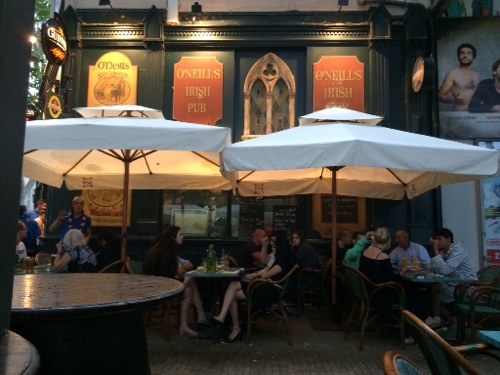
Fortunately, the Irish bar at the street corner serves an awesome Grumbachen Blonde (for my straight friends, that's beer), so the tedium was finally broken with proper flare.

Our first meal was at an open air restaurant in front of the Hotel de Ville (“city hall” for you neophites…and me), where a dozen restaurants squat cheek by masticating jowl (ugly metaphor). The meal was great and most interesting was Rod's capresé salad made with a lightly breaded, pan-fried mozarella. Nothing sparks up a slab of fat like frying it. Good wine, good company, no popes anywhere, who could ask for more?


Driving

Those who know anything about my driving experience in Oxford, where I hit a tiny red two story bus, might find it odd that I got back on the mechanical horse in Lyon. It is fortunate that I trained in aggressive driving on the unforgiving streets of Boston, but bean-town had training wheels by comparison with France. Everyone in this country still dreams of competing in the Grand Prix and where better to practice than on the narrow country roads of Provence?

The French throw away bread after 3.5 hours, but asphalt is not squandered. The width of a typical non-highway road is about what the US gives to SUVs in lined parking spaces (where few can manage to stay between them). One drives between 50 and 110 km/hr and the only thing that keeps the opposing vehicles from scratching each other’s door paint is the Bernoulli effect. It is simply a matter of blind faith, passed down from Joan d’Arc, that one will avoid a head-on engagement. (And recalling Joan’s own end does not help.)

The Brits like their “round-abouts,” where intersecting roadways meet in a centrifuge that toss motorists onto 3, 4, or 6 different exits, but the French love them. Once popular in New England under the name “rotary,” the configuration is a horror to Americans from other parts of the country who consider the automobile a combination of hair salon and phone booth. Rotaries demand attention and rapid decision making. Speed reading is a must. Not a substitute for the overpass, the French are installing more and more of them. They are fabulously efficient. Best negotiated with a standard shift, when traffic is light you can sail through one intersection after another without stopping.

The French keep to the right on divided highways except when passing. They always signal lane changes and intended turns. I could kiss them on three alternating cheeks for it. And while fast driving seems to suggest impatience, no one beeped at this clumsy tourist trying to work out how to make 7.40 euros from a fistful of foreign coins at a toll booth.

One little bit of advice if you intend to drive in France—get the smallest car you can possibly get by with. Even modern parking garages have curls that will turn your hair. Americans have left rain forests of rubber and mega-liters of paint on the bumpers of narrow streets and walls of ancient ruins.

Language

One takes it that English, with its limited emotion, is the language of business; Italian, on the border of hysteria, of irritation; Spanish, of enthusiasm; German, argument—”Agree or I will keep spitting on you”; but French, when spoken softly, is the talk of love.

I do not understand many words in French, but I can read the speaker’s intention. And so it was when I suspected one young man say to an other, I want to put my tongue where no other has. In the second man’s brief hesitation, I could see the obvious question, Inner ear or nasal cavity? His final decision was, “Sure, why not.” The French are an agreeable lot.


Lyon

The trip from Paris is easy on a high speed TVG—quiet, comfy, air conditioned. Only one stop between the two cities, we rolled past miles of sparsely populated farmland; the French reject city sprawl.

Neither of us knew anything about Lyon, so just going there seemed a tad chancy. It’s a large city, and the hotel was also a stab in the dark. Sometimes leaving one’s destiny to the fates works out. And so it was with Lyon.

HDRtist HDR - http://www.ohanaware.com/hdrtist/

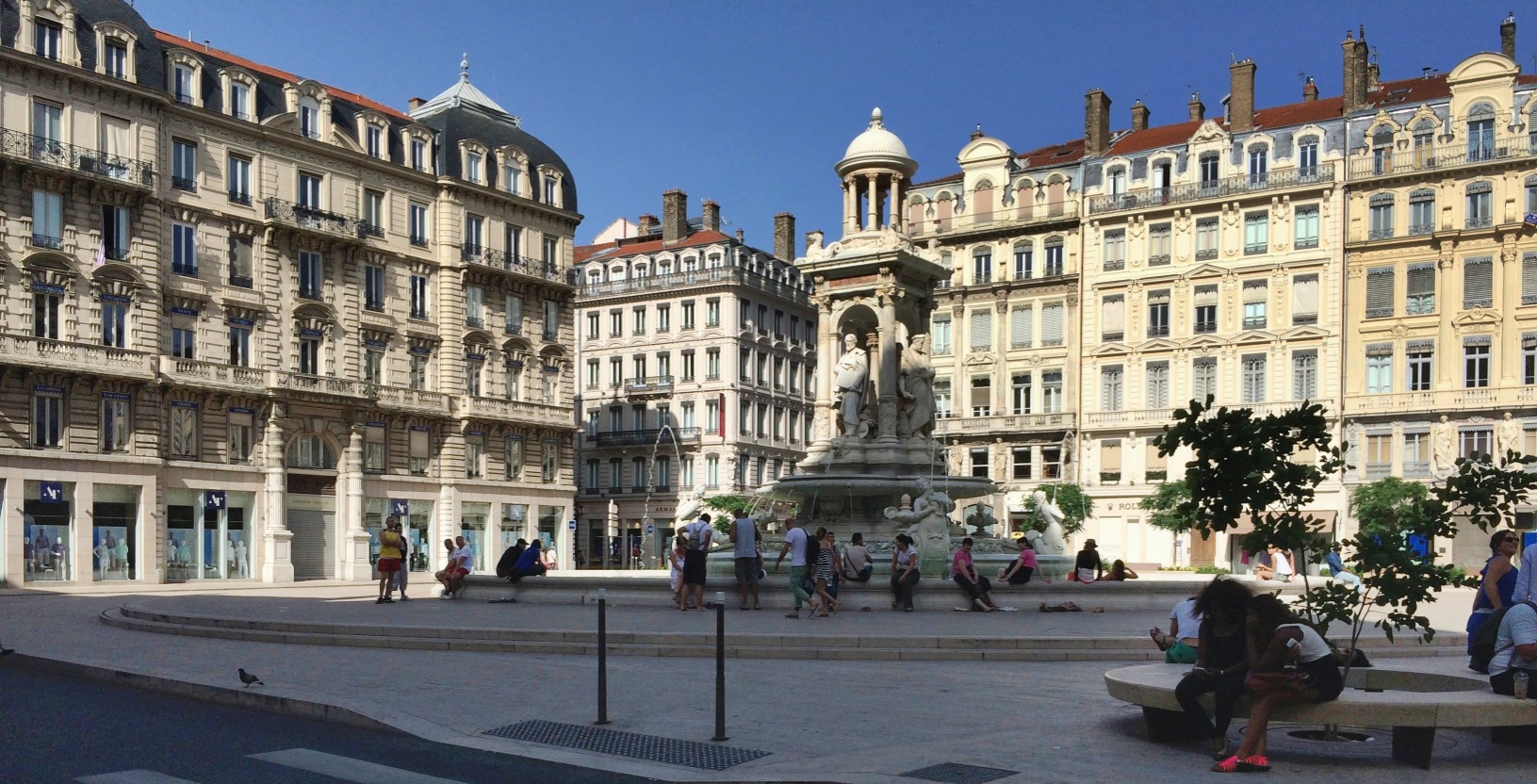
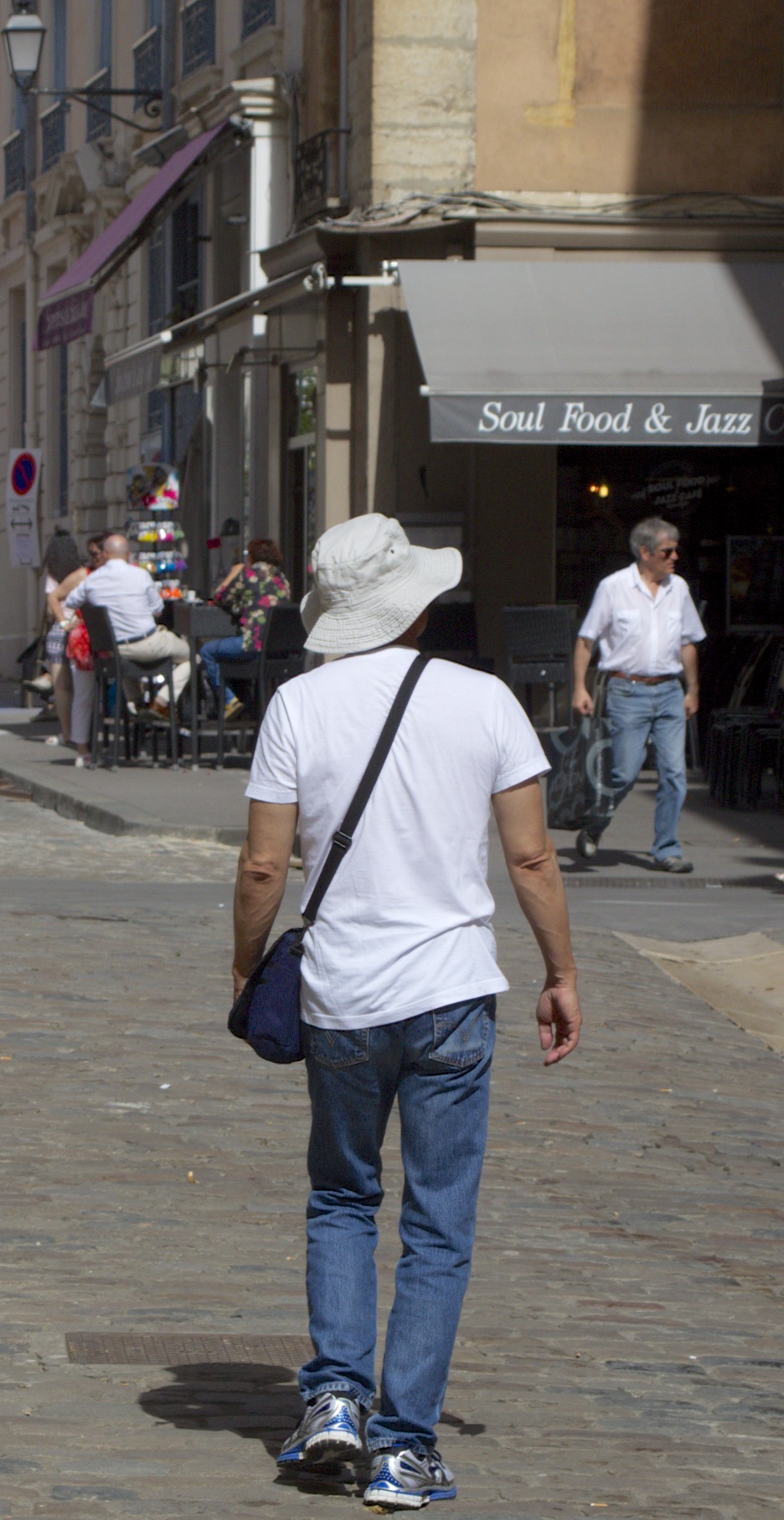
We dropped our bags and set off in the sweltering Sunday heat at about 15:00. The place was deserted. Two blocks from the hotel, toward the Saône River lies a pedestrian-only street (there’s an occasional motorcycle, but you find those racing down the hallways of most hotels) lined on both sides with outdoor cafés. Seats galore.

Lyon 53

Hours later, looking for a seat for dinner, and ruling out the pizza joints and other crap, there was nothing. Sure, indoors, where there was not a hint of breeze, the chairs were gathering dust, but of the hundreds earlier vacant in the evening heat, not a rickety chair was absent a warm fanny.

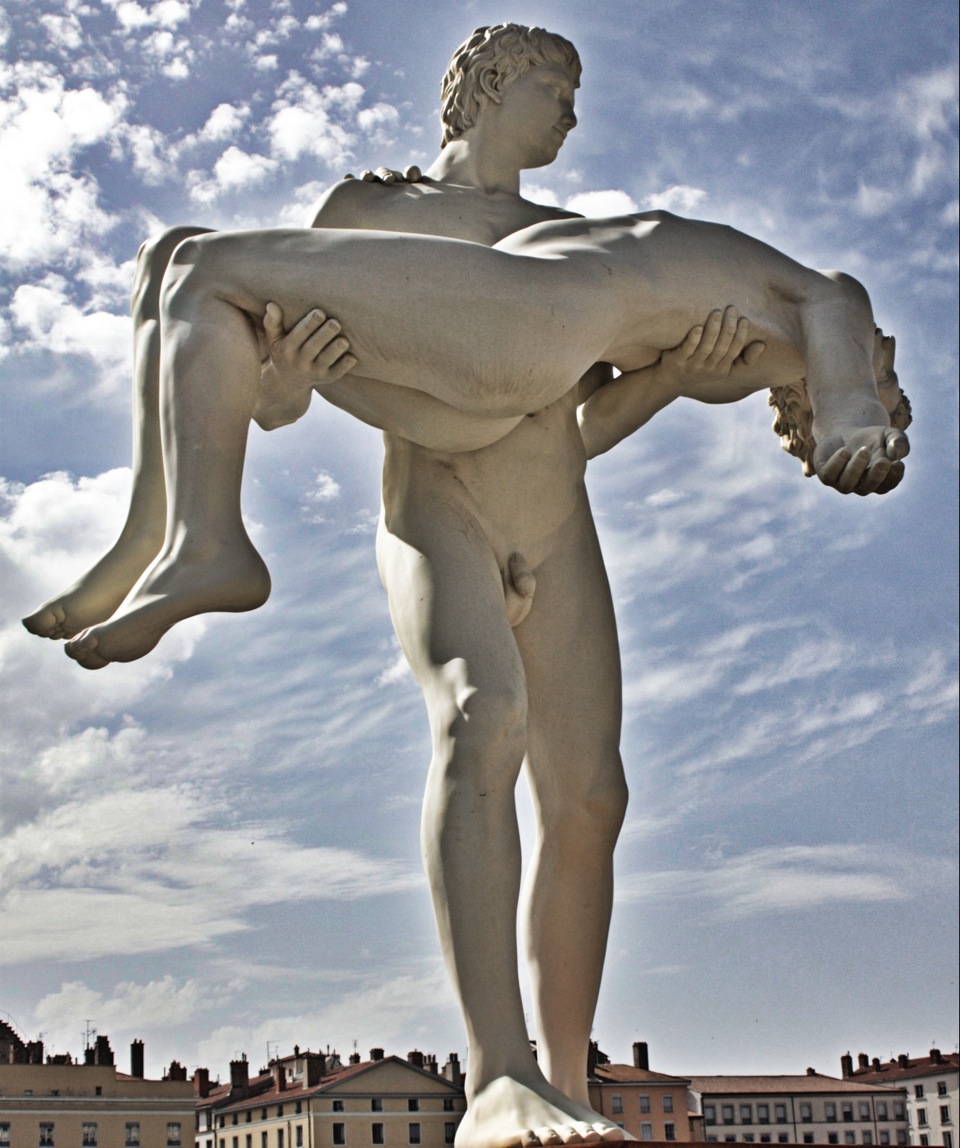
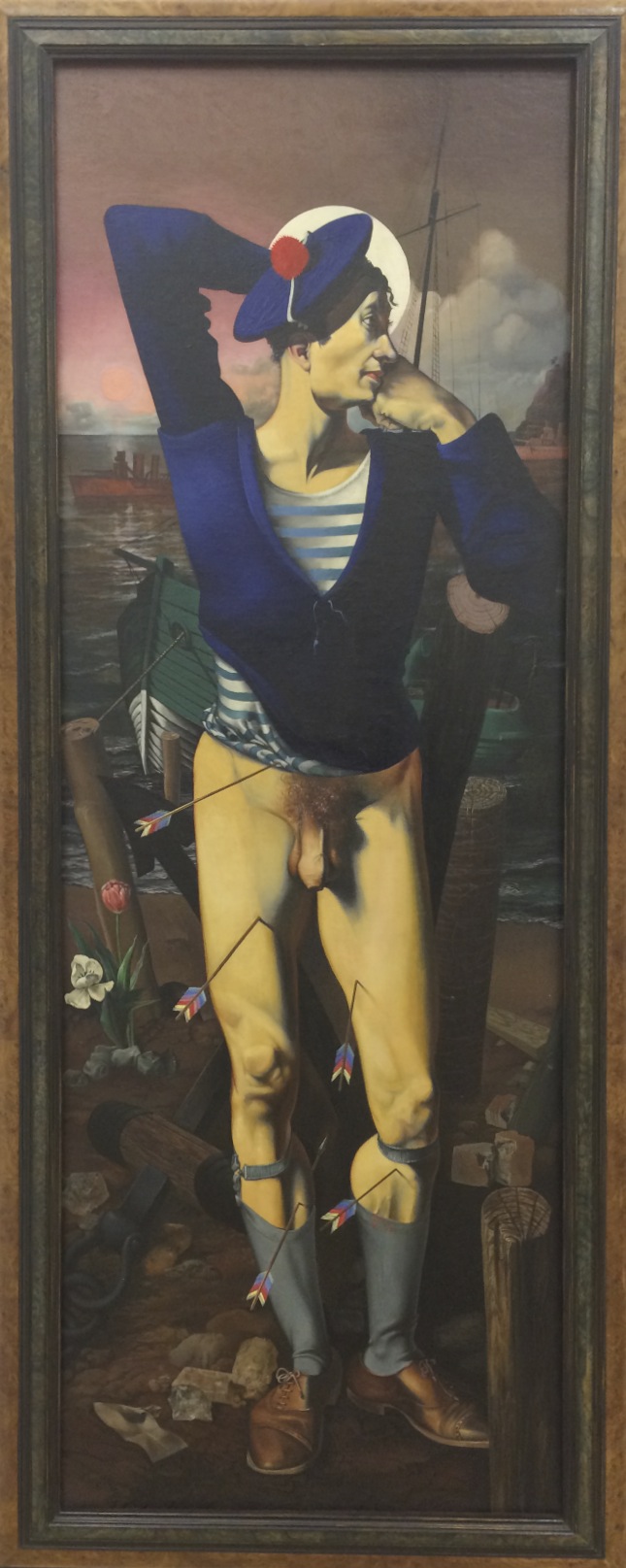
Mildly discouraged, we crossed a long foot bridge (now that sounds like an oxymoron) we were astonished to find this, apparently homo-erotic, statue on the distant side.

Lyon 56

Not exactly what it first appears, it is a political statement and is called “The Weight of Oneself,” referring to societies (like ours) that leave people to fend for themselves. The statue is carrying a copy of himself, not just a guy with narcissism issues. It is hard to imagine a man so engagingly dressed without offers of support from somewhere.

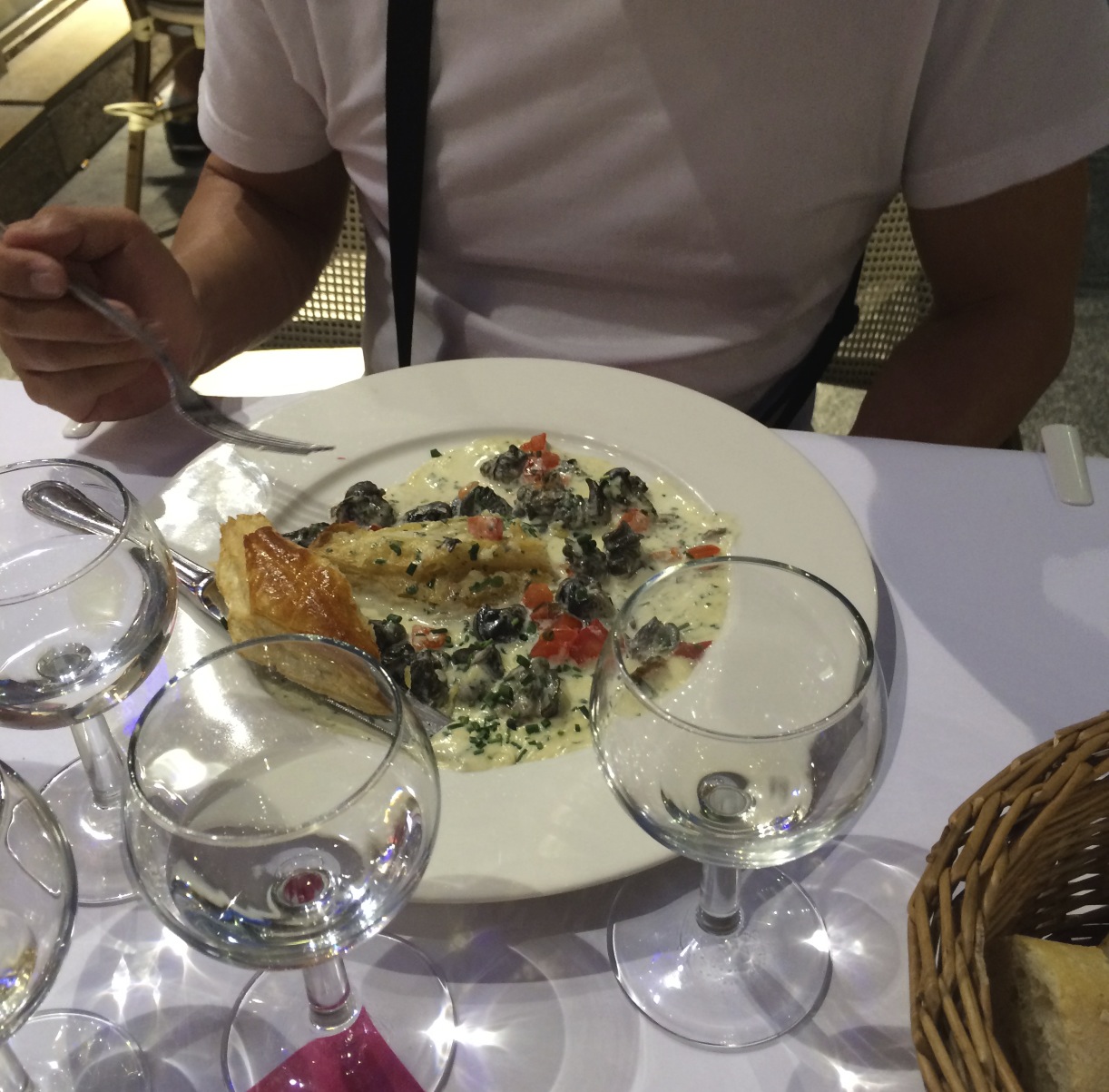
We found a table at one of the best restaurants seated next to four “family” members. The cute one smoked…how sad. We acknowledged each other with nods, but conversation between our disparate tongues (a loaded phrase, to be sure) was impossible.

Lyon 2

Lyon is a foodie’s paradise. Both nights were fantastic experiences.

Boat on Seine

Aside

Foolishly, we did not sleep on the plane, but watched an old movie, Godfather III. Lots of people got killed and I think the Pope did it. Bullets were sprayed about like holy water. I digress.

Paris 8We were determined to stay awake until 16:00, so grabbing a boat tour (which was part of our City Pass) seemed like a good plan. Wishful thinking.
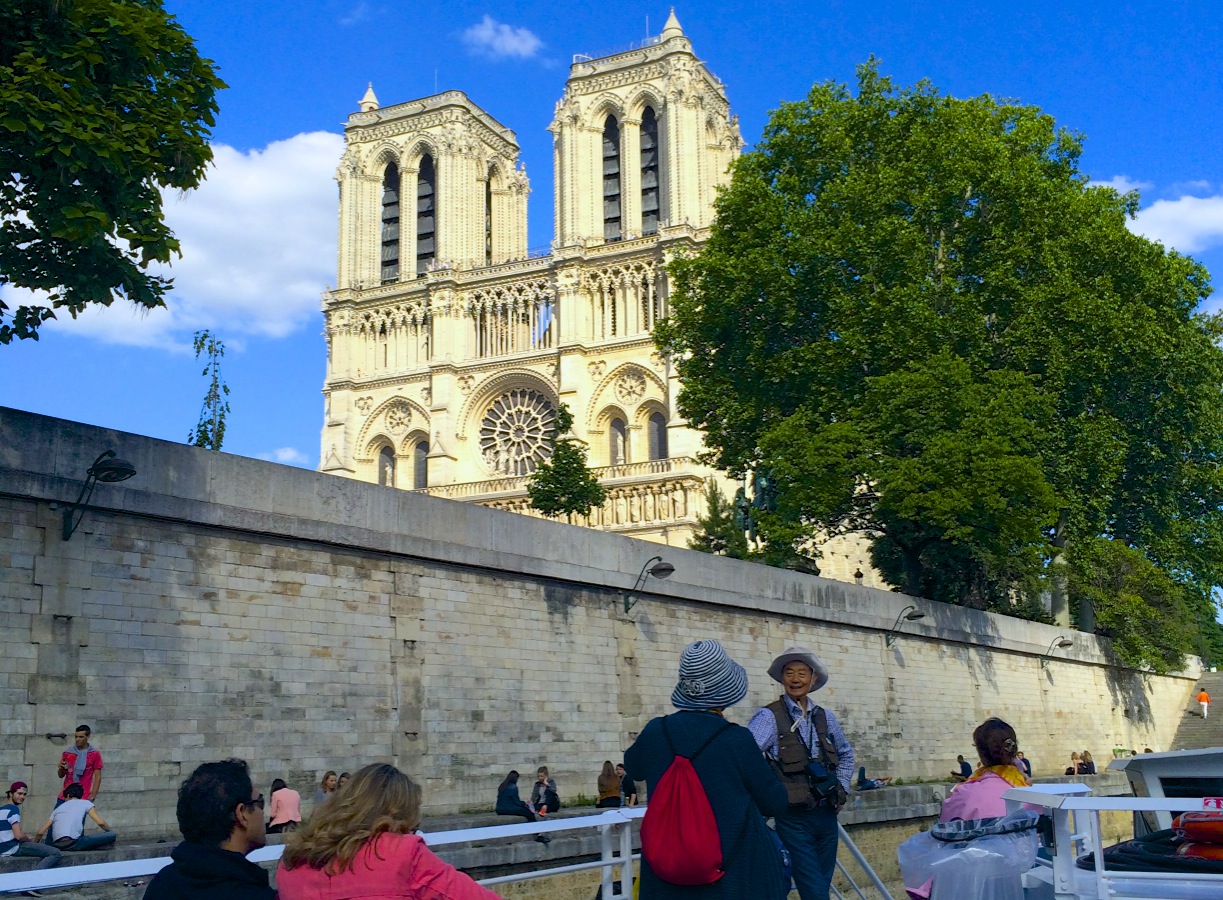
Paris 5As soon as we sat on the boat, I knew I would fall asleep, probably before shoving off. We had fortuitously chosen a vessel soon filled with Chinese tourists. Their method of moving about the boat, with a camera attached to their faces, required using the braille-hip method of getting from starboard to port, which jarred me regularly awake in time to see some of the important sights, like this big stone church.

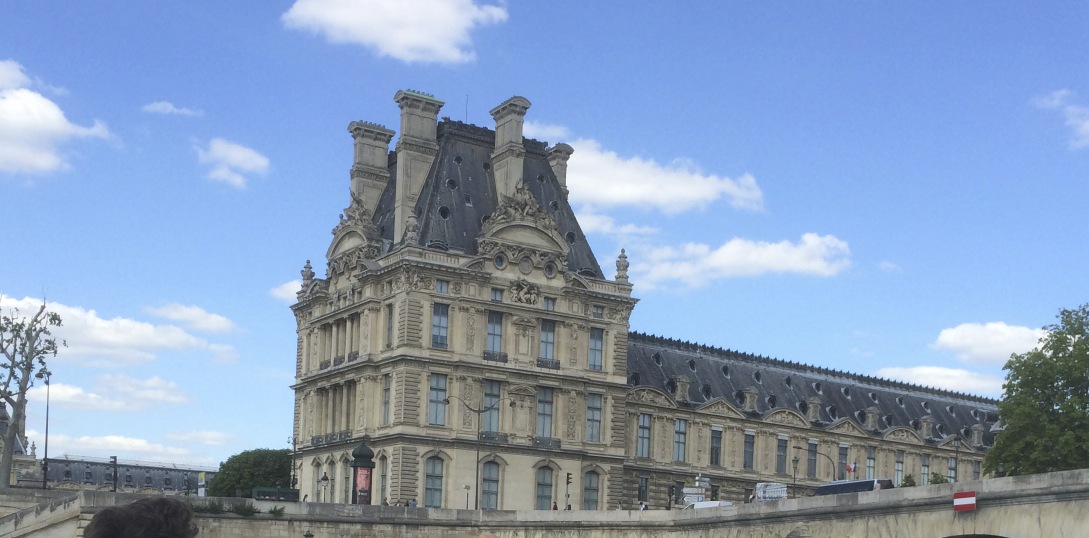
Paris 7The view of Paris from the river is fantastic, lined for miles with high stone walls, topped with the façades of countless palaces, chic hotels, imposing apartment buildings, and chubby tourists in garish pants. (The back end of any of these would diminish the effect substantially.)

THE CENTRE POMPIDOU

Image

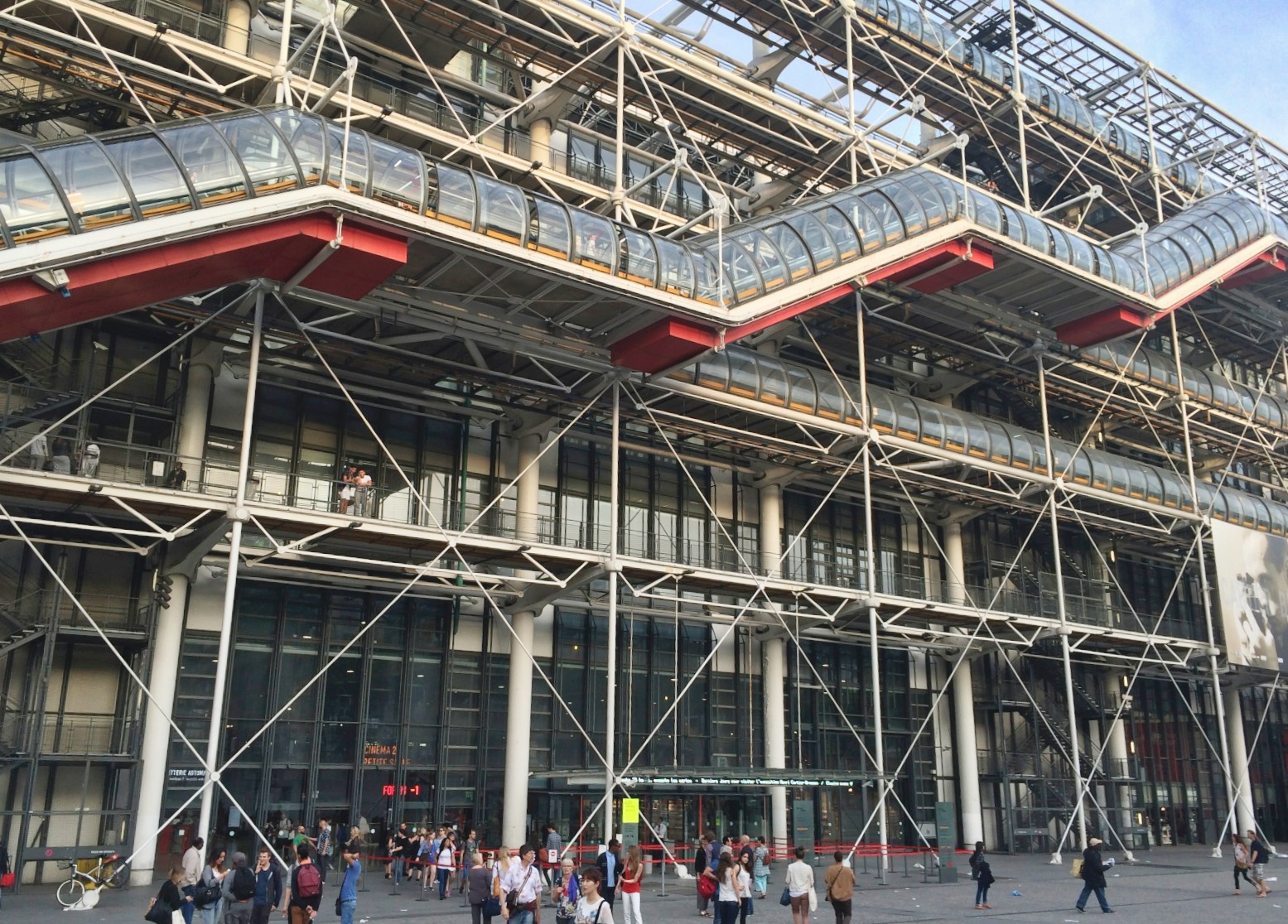
Perhaps we are supposed to see this structure like a fake mole on an actress’s blemish-free complexion. Buildings great and modest sport some form of refinement—from mansard crowns to iron balustrades guarding French doors down to the brass knockers on 12′ oaken portals—throughout the central  arrondissements municipal that comprise walkable Paris. The beloved Centre Pompidou is a notable exception. It resembles not so much a skeleton as a living body with the skin surgically removed. Ventilation shafts, plumbing, electrical conduit, and the columns and bracketing that hold the glass partitions and flooring in place are thoroughly exposed. It sparks the engineering curiosity of precocious children who can analyze the cause of the escalator failures here and there.

HDRtist HDR - http://www.ohanaware.com/hdrtist/

Though I found the space uninviting and confusing—get there early so that you can play “find the entrance,”—the modern art collection is unexpectedly spectacular. I offer two of my favorites:

Pompidou 1  The daily sacrament.

Pompidou 2 You missed me.

The Louvre

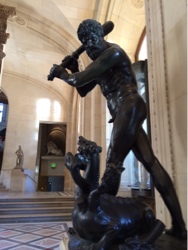
It’s big and has lots of art. ‘nough said ’bout that. One has to limit oneself to a few periods and accept that this museum is hard for the curator to master; a visitor has no chance. It spans from antiquity to the the point in time when the Paris art world rejected Impressionism, and if there is anything in it from Impressionism and beyond, I know not of it.

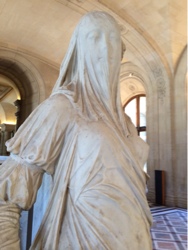
My favorite sculpture, aside of course from all the naked men in marble, is this piece in which the sculptor maded stone transparent:

How one sees through the stone veil to the face below is a mystery, but then all sculpture seems impossible to me. If someone were to write without a backspace key, I’d be shocked. So how to sculpt a hand without loping off a finger is beyond my comprehension—which leaves me to wonder how many male models complained, “Hey Mike, my dick’s bigger than that,” when the artist was careless with his chisel near the upper thigh.

We found a character from the Flemish period who is a spitting image of Matt Damon.

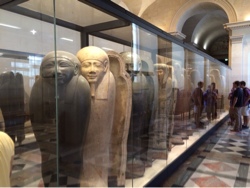
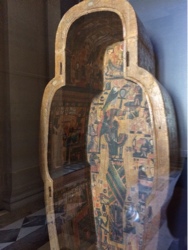
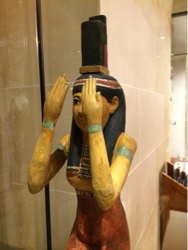
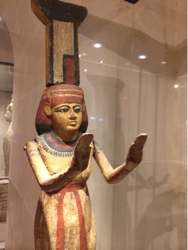
I learned the most from the Egyptian exhibits. For instance, poor pharaohs could buy off-the-rack sarcophagi. And some were equipped with late night reading, but the bandages probably got in the way. Egyptian mothers invented peek-a-boo, and I can now tell me lawyer friends that the original expression was “long arms of the mother-in-law.”


Arrival in Paris

The driver spoke no English. I speak no French, worthy of mention. That worked out fine. To my “Je m'appelle Bellerose,” he replied, “Enchanté” and already I was out of my depth. I have learned not to use a well-practiced French phrase as an introduction. This only encourages a spew of French that I have no hope of understanding. Get the language barrier, if there is to be one, out of the way first, then sprinkle the polite ouis and mercis with abandon.

Traffic was a horror. Both Obama and Putin were in town, though got no invite on AF1. (Obviously, the NSA knew I would be here.) The Americans are still determined to milk the liberation of Paris for all it's worth, though no one I know liberated it and no one they know was freed. Perhaps its time to call us square with Lafayette.

The city is more beautiful than I remembered. The Airbnb apartment…not so much. A dingy 5th floor walkup to a garret in desparate need of IKEA love. Rod is appalled. Looks like a local hotel and a forfeit of prepaid rent. However, it was almost worth it to discover the district called “Saint Germain.” We may never stay elsewhere else, though at the end of this trip, we will. We are a short walk from the Louvre and the Musee D'Orsay.


Summary

I wrote this blog for myself, finding that the expectation that someone might actually be reading it (unlikely as that might be) enough to keep me posting away when there were more laughs to have, beer to drink, sights to see. We made many new friends, but Christi, Robin, Mike, and especially Glenn saw us through some disappointments with good humor and high spirits, making our bus discomfiture quite tolerable. I will miss them all.

Donald Rumsfeld once made a derisive and divisive remark about “old Europe v new Europe,” but the continent continues to unify despite such idiocy. Though the US newspapers keep writing stories about the demise of the EU and euro, about ten countries are in some form of application to join. The EU is the world’s largest (or second largest, depending) economy. It appears to be delivering a higher standard of living to its citizens than any other, if stat tables, doubtless written by socialists, can be believed.

Some speak of “living in the past,” but the wisest of people live with the past. My impression of  the countries we visited (Belgium, Netherlands, Germany, Austria, Hungary) is one of people taking what has been left to them and enhancing it, perfecting it. The wonderful cities we saw are not reproductions of some time gone by, but are a fusion of yesterday and today. To live in a thoroughly modern world is to spend one’s life no deeper than civilization’s skin—its bones and muscle show how the past has created the present. The modern ancient city is like a Japanese garden, carefully pruned and shaped to look natural and spontaneous, when it is in fact crafted to be what it never was and could not have been without artful planning. The Las Vegas tradition of making copies misses this point altogether.

The most fascinating people to observe when traveling are the young, Their optimism, energy, interests, and behaviors are a vision of a world to come. A vision which may be inaccurate, certainly indefinite, but always compelling. They share one thing in common—the gift of life. Doubtless many will squander it; many will have their potential cut short by injustice and misfortune; but most of the people I met are living joyously in their part of the world with no desire to be someone else or live elsewhere.

Tourism as an economic force is remarkably large. Droves of people gawking at the cathedrals, traipsing through palaces, and meandering the streets of seventeen popular cities, out of hundreds like them, make up a spending engine that has unlimited potential. Viking Cruise Lines is currently building fourteen more ships, and there is plenty of competition on the rivers and oceans from other carriers. Crowds of people at restaurants and bars are enjoying life, each other’s company, and the labors of the less fortunate. The demand for more tourist space is improving these urban centers from the inside out.

Is the US keeping pace? Ironically, the disparity of wealth in America is more like medieval Europe than Europe of today will ever be again. A  few citizens are accumulating massive wealth and are independent of nationality. Their personal fortunes are less associated with their citizenship than any member of European royalty could have thought about their kingdoms.

We are told that our infrastructure is falling apart, but money goes to stadia and airports instead of high speed rail and neighborhood improvements (and needless conflict). One trusted investment advisor recommends shorting the euro against the dollar. It may be a wise strategy, but the signs of the euro’s weakness were hidden from me. A store in Budapest, where I bought a single shirt, had tags with prices in seven currencies, none was the US dollar. Euros are the currency of choice by those countries outside the euro. That might just be proximity, but the absence of the greenback was a small shock.

Who is on this ship of fools?

Budapest

Finally we docked in a city at the ideal location, though our tour started from outside the city on busses. This turned out to be a feature, not a bug.

Commie housing

Commie Housing Sucks

We got to see the scars of communism. Central planners devised an ingenious idea to fabricate countless thin cement slabs that could then be rapidly dispatched, house-of-cards style, to build enough 500 square foot, cold-in-the-winter, hot-in-the-summer apartments to house three million residents so that everyone could hear everyone else. (We have the NSA instead.) Extending for miles, they are butt ugly.

The communists were uncommonly fond of concrete. For one stretch of roadway, all the utility poles are of poured concrete, cinder-block style, tapering modestly to the top. They stand straight, I’ll give them that, but I suspect that any that did not stand straight did not stand for long (consult Aesop). Since I never saw them repeated elsewhere, I presume they were a failed experiment and their inventor probably spent his subsequent years in a gulag just south of the arctic circle.

Regensberg 1168

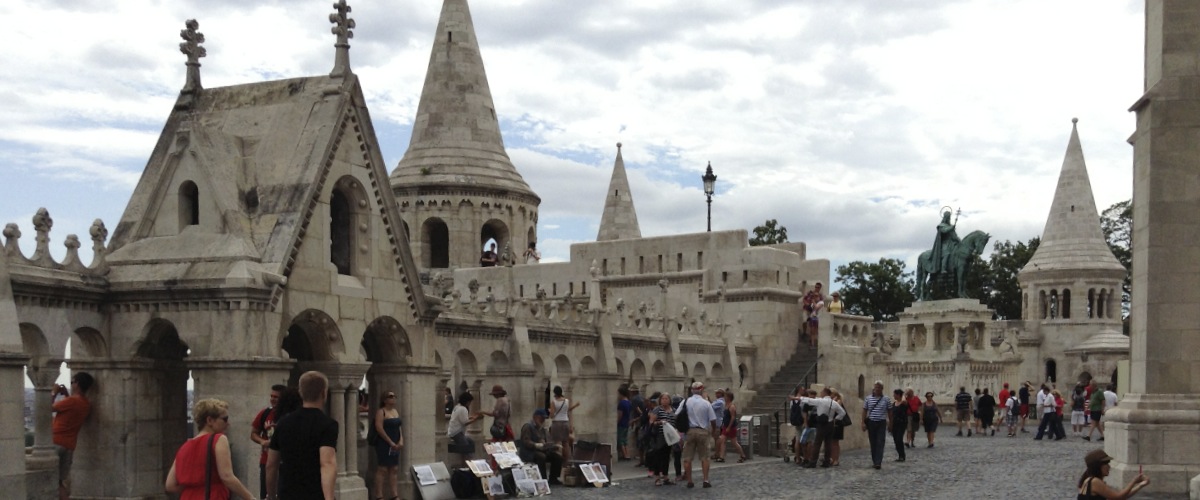
The communist history introduction we all agreed was depressing, but subsequent walks about Budapest left us all feeling a great love for the city. After dinner, we six took a stroll across the chain bridge, a suspension marvel of the mid-1800s, in a warm evening of shorts and tees. The lights from both sides of the city (Buda on the west; Pest on the east) are unspeakably beautiful from the bridge.

Regensberg 1180

Robin and Christi on the Chain Bridge, last night

Unable to toss my companions from Amsterdam into the Danube (I am not speaking of Robin and Christi), I left it, lighter and pipe included, on a handrail in the center of the bridge in the altruistic hope that some lucky traveler might enjoy a few more nights as I did, in blissful reflection of what a wonderful world has been left to us by the efforts of others, many long gone, and just as many still devoted to cherishing and improving our rich, sometimes cruel, often funny, enduring civilization. (#hashtag)

Vienna

Vienna 4

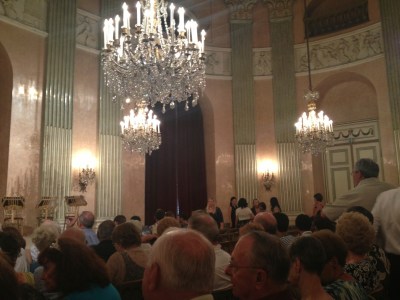
Still unable to reach Vienna on schedule, the program director decided that the situation required more imagination than a lunch with free beer. He managed to get a full set of tickets to a concert in Vienna, free of charge to any who want to attend—like we had other plans? This was a wild success. The hall is a small oval, but bigger than Mr. Obama’s office and with many more chandeliers. The stage held twelve musicians comfortably, one wielding a Stradivarius made in the early 1700s is the first violinist. She recklessly moved her music stand about to accommodate singers and dancers, leaving me in breathless anticipation of the moment when the corner of a baroque furnishing would tunnel through the priceless sounding boards. She is obviously less clumsy than I. We are asked to take no pictures during the performance.

For those who think that an intimate setting in a famous concert hall in the “city of music” might be a stuffy affair, where did you get that idea? The ballet was sometimes slapstick, the duets comic, and several pieces were sing-along or clap-along. Warm-up rock bands would have been jealous of the connection between these few players in gowns and tuxedos, playing in evening heat, and their appreciative audience. The profit of the sail, eroding with every bus shuttle, took a serious hit, but the name Viking had much of its tarnish removed.

The next day’s tour started out in breezy, moderately warm weather, so we were lulled into believing that a self-directed walk-about was in order. This was a mistake as we could have visited any of dozens of air-conditioned museums. The afternoon heat struck during our sidewalk lunch and by the time we left the restaurant, our will to do more than stuff ice cream into our mouths had melted away. (There are greater disappointments in life.) We agreed that Vienna demands another visit of several days.

The Hapsburg Dynasty, which lasted 650 years, built a palatial compound in the center of the city comprising 2800 rooms—who could squeeze into fewer? There are gigantic statues of nearly naked fighters and building-holder-uppers with ingenious, if unlikely, drapes of cloth or affixed fig leaves covering all male genitalia. For a family that pumped out its offspring to decamp in every monarchy west of the Mongolian steppes, they were clearly not willing to give credit where it was due.

Every guide and taxi driver boasts of Johann Strauss, Mozart, Beethoven, Brahms, and a dozen other composers, but no mention of poor Salieari, inspiration and villain of the play and movie, Amadeus. Our guide showed us the horse stables where some form of horse breeding brought about an impressive breed of show horse that is born black but turns white gradually in its adulthood. The guide called them “Michael Jackson horses.” America always gets its due.

Vienna 1

I call it, “Two men in need of a bidet.”

Despite its history of being the center of royalty for centuries, Vienna is today a city of the people. There are generous public parks, bike paths set off from both the sidewalks and streets, and a fabulous subway system. The subway is inexpensive, has no turnstiles (honor system), and has broad stairways to handle crowds quickly. The cars are clean and air conditioned.

Passau

It is really sad that our ship could not dock here because the landing is so convenient—we could have planned dinner or late evening walks. Instead, we still are using busses. Another disappointment is that we were unable to make it to the Friday concert at St. Stephen’s, which claims to have the biggest organ in Europe, our bus having been 15 minutes late and the doors were found locked to prevent disruption. From outside the thick walls, Rod and I could barely hear what must be mind-splitting sound.

The day was getting warmer and we foolishly wandered the scorched streets on our own. The guided tours have been informative and enjoyable, but there have been many tedious moments waiting for the deaf and lame to click their carefully composed photos and then search the mobs for a guide paddle with their forgotten group number. The guides are apparently scolded for losing a grandparent along the way, so the commentary is regularly interrupted by head counts. I am astonished at how infrequently a passenger was lured away from the group by a window trinket or an unauthorized call to the WC.

Since this whole blog is just so much practice, I am including a movie from scraps of iPad video available. I am unsure whether this will actually play on a computer. To understand the pointless organization of this insert, one has to attempt to understand that at the time of their recording, there was no particular plan as to how it might have been organized.

As I pre-defend my efforts, let me say that one must slog through crude and dull to get adequately discouraged (or blindly waste friends’ time who do not have the nerve to announce, “I’m not going to watch that shit.”).

A sidewalk café gave us a taste of food that the locals eat—the free meals offered as part of the Viking service were decidedly unvegetarian and few restaurants can bring their A game to a variety-free meal served at once to dozens of beer swilling layabouts. Instead, I had a simple, tasty salad with a side of croquettes made from chopped cauliflower and cheese. Having promised myself not to go on about food, let me briefly say that the ability of the Germans to fry almost anything mashable into perfectly shaped, delightfully browned delicacies is astonishing.

Passau was the hardest hit town in Bavaria by the floods this year. The founders foolishly decided that settling at the confluence of three rivers would assure them visitors and potable water. I suppose both are true, but the early visitors were often carrying swords and bad intent while the more recent impede sidewalk use and diminish the carefully honed beauty with questionable outerwear. I found a shop that had used its front window to show the mud and debris that had been piled up on the street directly outside. The recovery was incredible.

Here are a window photo of the aftermath followed by a picture of the same spot during our visit:

Passau 4

Note the restaurant arch in the lower left, which shows the water level.

Passau 5

Though the street was packed in mud and debris, everything was hosed clean.

In the late afternoon, having 45 minutes left to spend, we wandered back to St. Stephen’s where a mass of some sort was going on. We boldly went to the back of the church and shot some video, in the clip above. As part of the service, two organ pieces, both with voice accompaniment, one solo, one congregation, gave us a chance to hear the unmatched acoustics of these pipes in a Baroque setting. It’s a wow.

On the hottest day in Passau’s history, two idiots (a smartly dressed sex change and her elderly mother) delayed our leaving by 45 minutes, pissing off everyone on three stranded busses when admitting that they just took their time because there was “always a delay.” This faux pas will exact a serious drink penalty.